

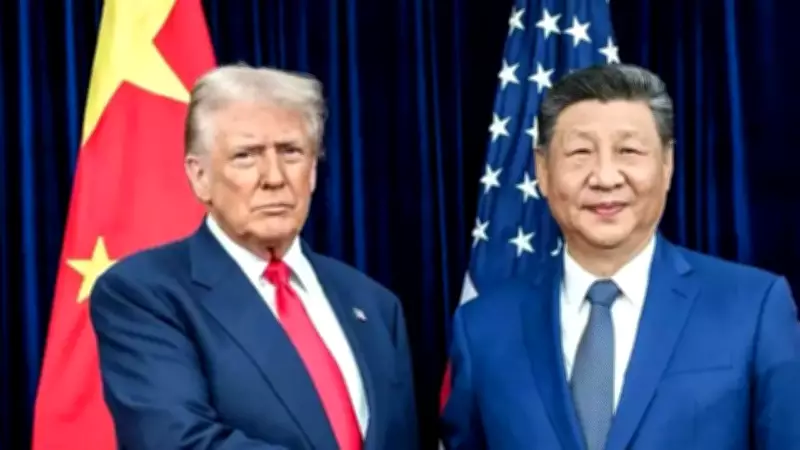
Trump Issues Stark Warning to China Over Potential Iran Military Support
In a dramatic television interview, former US President Donald Trump issued a severe economic threat against China, warning of imposing "staggering" new tariffs if Beijing provides military assistance to Iran during the ongoing Middle East conflict. The remarks came during an appearance on Fox News' Sunday Morning Futures program, where host Maria Bartiromo directly questioned Trump about his previous warnings regarding countries aiding Iran.
"Staggering" Tariffs Threat Against China
When asked specifically if his warning of 50% tariffs applied to China, Trump responded unequivocally: "Yes, China and potentially others. But specifically, yes, China is included." The former president acknowledged hearing reports about China potentially providing shoulder-fired anti-aircraft missiles to Iran but expressed skepticism about their accuracy.
"I've heard reports, and I don't always trust news reports, claiming that China is giving shoulder-fired anti-aircraft missiles. I'm not sure that's accurate. I doubt they would do that. Maybe they did a little bit at the beginning," Trump stated during the interview.

He then delivered his stark warning with characteristic bluntness: "If we catch them doing that, they get a 50 percent tariff, which is a staggering, that's a staggering amount."
Confidence in Negotiations and Military Capabilities
Speaking about the broader conflict with Iran, Trump expressed remarkable confidence that Tehran would eventually return to negotiations on American terms. "I predict they come back and they give us everything we want," he declared, adding emphatically, "I want everything... They have no cards."
The former president defended his previous hardline rhetoric, including his controversial statement that "a whole civilization will die tonight," claiming such declarations had successfully pushed Iran toward the bargaining table. "That statement got them to the bargaining table, and they haven't left it," he asserted.
Trump also reiterated the United States' military capabilities against Iran, making extraordinary claims about America's destructive power. "I could take out Iran in one day. I could have their entire energy everything, every one of their plants, their electric generating plants, which is a big deal," he stated.
He elaborated on the potential consequences of such action: "And I hate to do it, because if I do it, it takes you 10 years to rebuild. They'll never be able to rebuild it. And the other thing you take out are the bridges," warning that such infrastructure damage could require years of reconstruction efforts.
Escalating Tensions in the Strait of Hormuz
The former president announced significant military measures regarding the strategically vital Strait of Hormuz, through which approximately one-fifth of the world's oil passes. Trump revealed that the United States and its allies would deploy minesweepers to clear Iranian mines from the critical waterway.
"We have minesweepers there... and we're also bringing in more traditional minesweepers," he explained, noting that countries like the United Kingdom were contributing to these efforts.
Earlier, in a post on his Truth Social platform, Trump had declared a much tougher stance, writing: "Effective immediately, the United States Navy... will begin the process of BLOCKADING any and all Ships trying to enter, or leave, the Strait of Hormuz."
He followed this with an even more aggressive warning: "Any Iranian who fires at us, or at peaceful vessels, will be BLOWN TO HELL!"
Accusing Tehran of restricting maritime traffic and potentially charging tolls, Trump characterized these actions as "WORLD EXTORTION" and warned that vessels paying such tolls would be intercepted by American forces.
Iranian Response and Diplomatic Context
Iran's Revolutionary Guards responded defiantly to Trump's threats, asserting they maintain full control over the strategic waterway and warning of severe consequences for any hostile action against Iranian interests.

These escalating tensions come against the backdrop of failed diplomatic efforts to resolve the six-week conflict. A marathon 21-hour round of talks in Islamabad concluded without producing any breakthrough agreement.
US Vice President JD Vance, who led the American delegation in these negotiations, stated that Washington had presented its "final and best offer" to Iran, adding cautiously, "We'll see if the Iranians accept it."
The combination of economic threats against China, military posturing in the Strait of Hormuz, and failed diplomatic efforts creates a volatile situation in the Middle East, with potential implications for global trade, energy markets, and international security arrangements.





