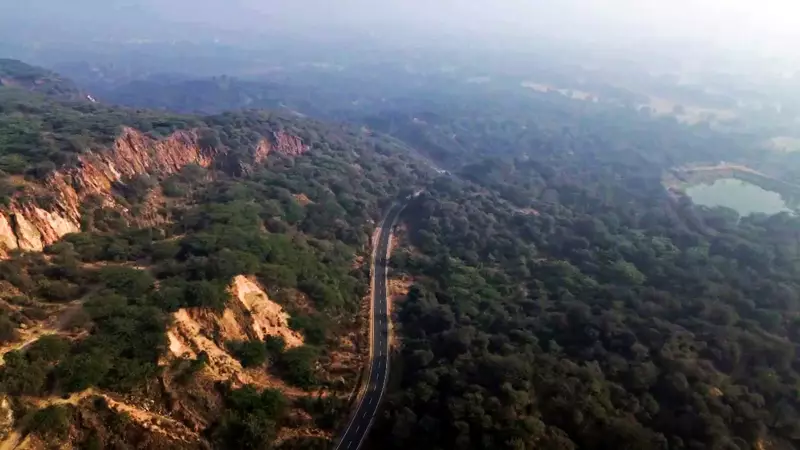
In a significant development concerning the protection of the ecologically fragile Aravalli range, it has emerged that a government-formed technical committee had earlier highlighted the need for more comprehensive studies to reliably define the hills. This revelation comes just before the Supreme Court's recent intervention to stay its own order and call for a review by domain experts.
The Technical Sub-Committee's Deliberations
Between June and October 2024, a technical sub-committee (TSC) constituted by the Union Environment Ministry held seven meetings to deliberate on a uniform methodology for defining the Aravalli hills and ranges. This panel was led by the Director General of the Forest Survey of India (FSI) and included officials from the Geological Survey of India (GSI) and the Survey of India (SoI).
The TSC's primary mandate was to submit its assessments to a larger, nine-member panel chaired by the Union Environment Secretary. This larger committee was itself formed on the orders of the Supreme Court and included bureaucrats from the environment ministry, the four Aravalli-spanning states—Rajasthan, Gujarat, Haryana, and Delhi—and representatives from the Supreme Court's Central Empowered Committee (CEC), FSI, and GSI.

Conflicting Methodologies and the Call for Further Study
During its deliberations, the TSC encountered differing approaches from member institutions. The FSI presented work based on a 3-degree-slope formula used in Rajasthan districts back in 2010-11. Conversely, the GSI proposed identifying the Aravallis as a "Proterozoic fold belt" with a slope of 8% (4.57 degrees) and a minimum height of 30 metres.
Records indicate that the FSI and SoI did not agree on setting a "hard threshold" based solely on slope or elevation. The sub-committee report noted that the hill terrain varies significantly across the region, making a uniform, strict criteria impractical. A critical finding was that all tested methods produced false positives and false negatives. This meant habitation areas were sometimes incorrectly included, while plateaus were excluded, and hills with gentler slopes, including foothills, were left out.
Consequently, the TSC concluded that more work was essential to finalize a delineation method that would "provide reproducible results associated with landform modelling." Despite this recommendation, the larger ministry-led panel eventually proposed an operational definition for the Supreme Court based on a 100-metre elevation and slope criteria, intended for uniform application, particularly in mining contexts.
Supreme Court Intervention and State Responses
The ministry panel's 100-metre definition faced opposition from the Supreme Court's CEC and the amicus curiae. An internal FSI assessment of digital relief data had cautioned that this definition would leave over 90% of the Aravalli hills unprotected. Taking suo motu cognizance of these concerns, a Supreme Court bench headed by Chief Justice of India Surya Kant stayed the order on December 29, 2025.
The court directed that a high-powered committee of domain experts must examine areas excluded from protection under the new definition and assess the risk of their degradation. This move effectively called for a re-examination of the issues the TSC had already scrutinized.
When consulted by the larger panel, the stakeholder states had varied responses. While Rajasthan, Gujarat, and Haryana broadly consented to the 100-metre definition, Haryana suggested incorporating an age-based geological criterion alongside the elevation parameter. The Centre-led panel rejected this, arguing that while geological origin provides scientific context, regulatory purposes require readily verifiable parameters like elevation and slope protection.
The ongoing legal and scientific tussle underscores the complex challenge of defining a ancient mountain range for contemporary conservation, balancing ecological imperatives with regulatory clarity.