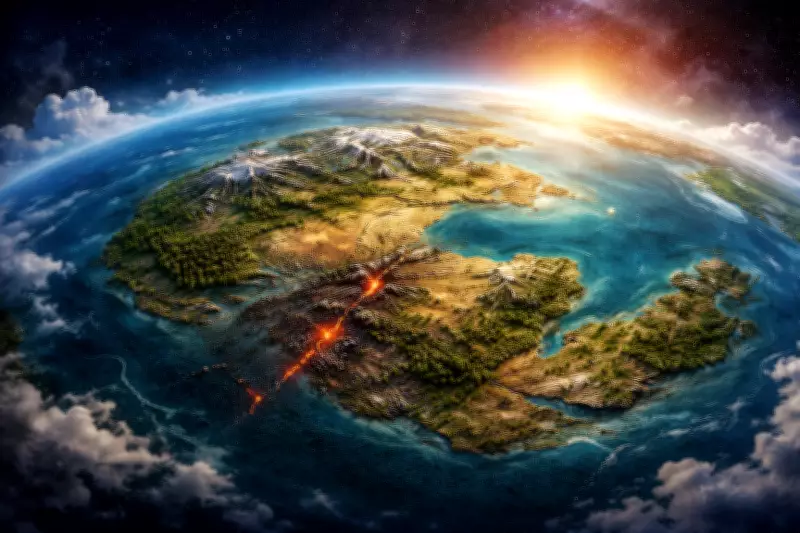
The Era of Pangaea: Earth's United Landmass
For an immense span of geological time, the continents of Earth were not isolated by vast oceans as they are today. Instead, they were fused into a colossal single landmass known as Pangaea. This supercontinent assembled gradually over tens of millions of years through relentless tectonic collisions, with no definitive starting point. Landmasses simply continued drifting together until separation became the exception rather than the rule.
A World Before Modern Life
Pangaea existed long before the emergence of humans, mammals, or even flowering plants. In geological terms, it remained stable for a period, but its unity was inherently temporary. Once the continents locked together, the planet's dynamics shifted dramatically. Vast interior regions lay far from oceanic influences, causing rain to struggle to reach central areas. Seasonal temperature swings became more extreme, with some zones experiencing intense heat while others faced freezing conditions.
This was not a world of gentle environmental gradients. Coastlines were limited, and expansive deserts dominated the interior. Forests primarily survived along the fringes, and ice advanced and retreated at various times depending on global climatic conditions. Much of our understanding of Pangaea derives from analyzing rock layers and sophisticated climate models, as direct evidence from that era is scarce.

Life and Movement Across Pangaea
With no oceans acting as barriers, plants and animals could migrate across enormous distances. This explains why similar fossils are found today on continents now separated by thousands of kilometers. Reptiles, early mammals, and ancient plants left traces across what are now distinct continents. However, access did not equate to hospitable conditions. Many regions were harsh and unforgiving.
Life clustered where conditions permitted and vanished where they did not. Survival depended less on mobility and more on tolerance to extreme environments. Pangaea did not fracture abruptly; the process began with heat accumulation beneath the thick continental crust. Weak points developed, volcanic activity increased along fractures, and the land gradually stretched.
The Great Breakup and Its Consequences
Cracks widened, valleys formed, and eventually water filled these spaces. New oceans originated as narrow seams before expanding over time. The breakup was slow, uneven, and irreversible once it reached a critical stage. This fragmentation reshaped Earth's long-term climate dramatically.
As Pangaea broke apart, coastlines multiplied, ocean currents shifted, and moist air could once again penetrate inland. Rainfall patterns transformed, some deserts contracted, and novel ecosystems emerged. These changes did not occur instantaneously; species adapted, migrated, or faced extinction. The world became more fragmented but also more climatically diverse, setting the stage for the rise of many modern ecosystems.
Pangaea's Enduring Legacy
The influence of Pangaea did not cease with its disintegration. Mountain chains align across oceans, rock layers match between continents, and even coastline shapes hint at the former unity of the land. Geologists view Pangaea as part of a cyclical process rather than an anomaly. Supercontinents form, break apart, and eventually reassemble, with tectonic plates continuing to move today.
Pangaea is often regarded as ancient history, but it serves as a powerful reminder. While continents appear permanent, they are merely temporary arrangements in Earth's ongoing geological narrative, a story that continues to unfold with each passing epoch.