Parrot Snakes: The Agile Green Hunters of American Rainforests
In the lush rainforests of Central and South America, a strikingly bright green serpent moves with silent grace through the dense canopy. Known as the parrot snake, this long, slender reptile is a master of stealth and agility, defying its delicate appearance to become a highly skilled predator. Experts classify it under the Leptophis genus, where its remarkable adaptations shine.
Physical Traits and Camouflage
Parrot snakes are exceptionally slim, often exceeding five feet in length, yet appearing smaller due to their thin bodies. Their vivid green scales catch sunlight, creating a subtle sheen that enhances their camouflage. Large yellowish eyes provide excellent vision in dim light, crucial for spotting movement. Distinctive features include small rear teeth for gripping prey and a loreal scale between the eye and nostril, with lighter upper lips adding a faint contrast. This coloration isn't merely aesthetic—it's vital for survival, allowing them to blend seamlessly into foliage.
Subspecies and Habitat
Two primary subspecies exist: Leptophis ahaetulla, the most common, is bright green and widespread across the region, while Leptophis liocercus is rarer, often displaying duller olive or brownish-green hues. Both are arboreal, spending their lives in trees, with flexible, thin bodies enabling navigation through tight spaces and quiet movement among leaves. They thrive near water sources like rivers, ponds, and swamps, which offer abundant prey, though they occasionally venture into open woodlands or rural forest edges.

Hunting and Behavior
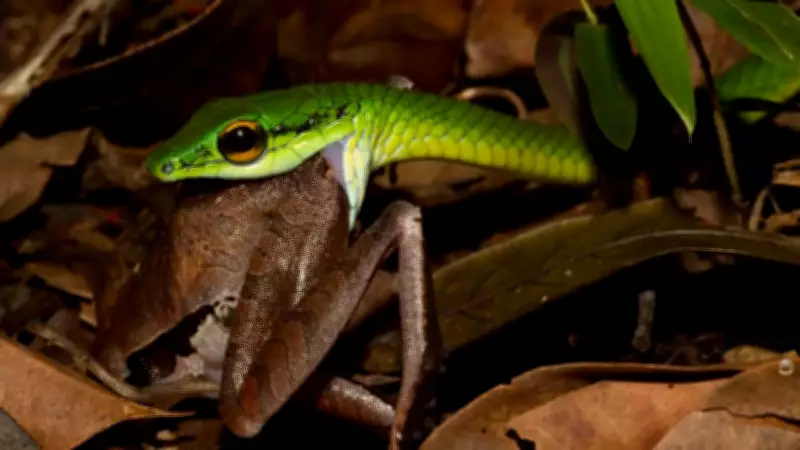
Parrot snakes are solitary and diurnal, most active during early mornings or late afternoons. They rely on sharp eyesight, quick reflexes, and climbing prowess to hunt small lizards, frogs, and even other snakes. Their hunting strategy combines patience, speed, and perfect camouflage, often targeting low branches or the forest floor. When threatened, they rear up and bite, using mild venom to subdue prey—though it poses little danger to humans. Their agility allows rapid escape into thick vegetation or up trees.
Reproduction and Conservation
These snakes reproduce by laying five to ten eggs, hidden in leaf litter or under logs. Hatchlings resemble miniature adults, with bright green coloration from birth, enabling immediate hunting and predator avoidance. Currently, parrot snakes are not endangered, but habitat loss from deforestation and human encroachment poses a growing threat, reducing hunting grounds and increasing exposure to predators. Conservation efforts are essential to protect their environment, benefiting not only these snakes but countless other species sharing the same ecosystem.
Researchers emphasize the need for patience in observing these elusive creatures, whose survival hinges on preserving the intricate balance of rainforest habitats. By safeguarding their natural homes, we ensure parrot snakes continue to thrive as agile icons of the wild.