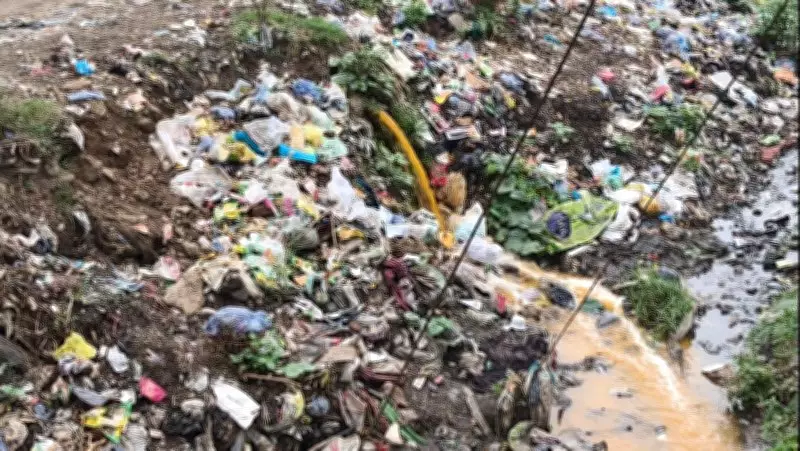
The Baddi industrial cluster in Solan district is grappling with a severe environmental crisis as plastic waste accumulates in public spaces, drains, and water bodies. The Baddi-Nalagarh national highway, link roads, and nullahs are strewn with colorful plastic waste and discarded clothes, creating foul odors and health hazards. The absence of dustbins has turned public areas into dumping grounds, exacerbated by a lack of civic sense among residents, many of whom are migrants.
Health and Ecological Risks
Experts warn that the plastic waste is causing long-term environmental degradation. “Plastic waste slows the degradation of biodegradable materials. It traps moisture, blocks airflow, and shields waste from sunlight and microbes while creating anaerobic conditions that lead to rot and greenhouse gas emission,” said a local environmental expert. The fragile ecosystem is under strain, with microplastics—particles smaller than 5 mm—forming as plastic waste degrades under sunlight. These microplastics enter the food chain through environmental contamination, posing risks to human health.
Government Measures and Challenges
The state government has implemented measures such as banning single-use plastic, but enforcement has been ineffective. Most commodities, from chips packets to grocery items and juice straws, are still packaged in single-use plastic. To address open littering, the government introduced the Himachal Pradesh Deposit Refund Scheme, 2025, which aims to encourage plastic buyback and discourage dumping. Dr. Suresh Attri, Chief Scientist-cum Joint Member Secretary, Department of Environment, stated, “This scheme, once implemented, will introduce a structured system for collecting non-biodegradable packaging waste based on the polluter pays principle, aiming to curb littering and improper disposal into drains, open spaces and on roads. By ensuring systematic recovery and recycling of such waste, the scheme supports environmental protection and actively advances the circular economy within Himachal Pradesh.”

Implementation and Public Responsibility
The department will soon invite tenders for engaging operators to make the scheme functional. However, experts emphasize that success depends on residents taking responsibility for proper waste disposal. The deposit refund scheme is positioned as an effective instrument for implementing Extended Producer Responsibility (EPR), but public cooperation is critical. Without civic engagement, the area risks an imminent environmental disaster despite government efforts.