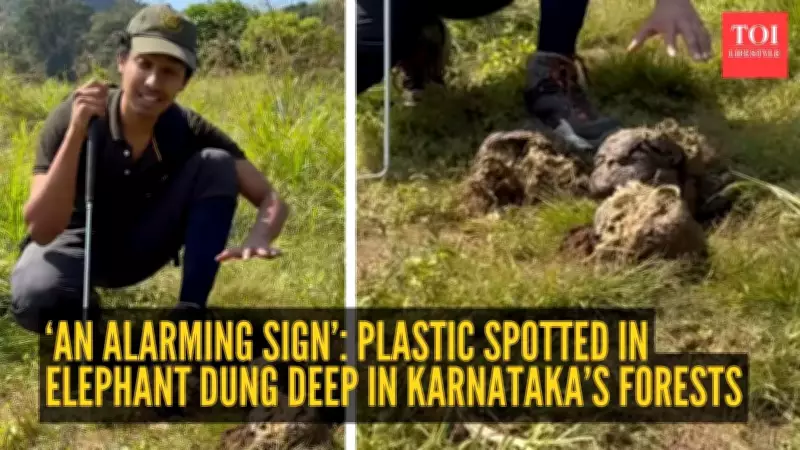
Plastic Pollution Reaches Remote Karnataka Forests as Elephant Dung Contains Human Waste
Even the most secluded and pristine forest ecosystems in India are no longer immune to the pervasive spread of human-generated waste. A recent and deeply concerning discovery from the Shola forests of Karnataka starkly illustrates how our everyday consumption habits and improper disposal practices are infiltrating areas once assumed to be untouched sanctuaries of nature. Once again, it is the innocent wildlife that bears the brunt of human negligence, paying a heavy price for our environmental carelessness.
A Disturbing Discovery in the Brahmagiri Hills
Renowned wildlife photographer and author Ishan Shanavas recently shared a troubling and eye-opening experience on his Instagram platform. While trekking through the remote Brahmagiri hills, part of Karnataka's ecologically sensitive Western Ghats, he encountered an unexpected and alarming sight: plastic fragments embedded within elephant dung. In his post, Shanavas expressed his dismay, writing, "Finding plastic in elephant dung deep inside the Shola forests of the Brahmagiri hills in Karnataka was deeply disturbing."
He emphasized that this particular forest region is far removed from regular human activity and should, by all accounts, remain pristine and clean. Yet, the plastic contamination was "clearly and unmistakably" visible, shattering the illusion of an untouched wilderness. In an accompanying video, Shanavas meticulously displayed the dung and elaborated on why this moment left a lasting impact on him. "This is something that is really disturbing. We have a pile of elephant dung, which would normally really excite me. Yet if you look closely, you can see that there is plastic within the dung." He described the find as "an alarming" indicator of how profoundly human behavior is affecting animal populations and their habitats.

The Broader Environmental Message and Implications
According to Shanavas, this unsettling discovery carries a significant and urgent message about our planetary impact. "This is a clear testament to how much we have changed this planet and how these creatures are now having to deal with our eccentricities," he stated. He further noted that such scenarios are entirely preventable "by simply disposing of waste properly." Reflecting on the remote location of his find, Shanavas added, "We're deep in the Shola forests, and yet we're seeing something like this. I think we can treat our animals and our planet better than this."
Why Plastic Poses a Grave Threat to Wildlife
Plastic pollution, though often appearing insignificant in isolated pieces, presents severe dangers to wildlife health and survival. Elephants, for instance, may inadvertently consume plastic while foraging near roadsides, tourist pathways, or other areas where human litter accumulates. Once ingested, plastic can cause:
- Internal injuries and lacerations to the digestive tract
- Life-threatening blockages that impair digestion and nutrient absorption
- Gradual accumulation of toxins that may leach into the animal's system
Over time, plastic waste does not remain stationary. It can travel deeper into forest ecosystems through water runoff or be transported by animals themselves, thereby spreading pollution to even more remote and vulnerable areas. This creates a cascading effect that compromises entire ecological networks.
Public Reaction and Calls for Responsibility
Shanavas's post resonated strongly with social media users, sparking widespread concern and dialogue. One user commented, "Sadly, it's becoming our reality; our littering habits are so overpowering that even after multiple interactions, people just don't give up." Another echoed the call for action, stating, "Rightly said, responsible disposal is a must!" The collective response underscores a growing public awareness and demand for stricter waste management practices and environmental stewardship.
Disclaimer: This report is based on a viral video shared on social media platforms. The authenticity of the video and the claims presented within it have not been independently verified by editorial teams.