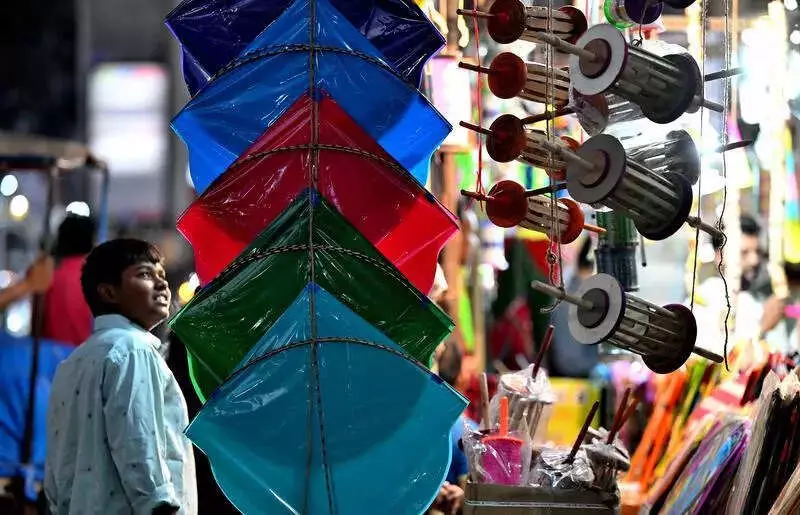
As Sankranti approaches, Hyderabad's kite markets are buzzing with activity. But something has changed dramatically in recent years. The traditional paper patangs that once defined the city's festive spirit are disappearing from stalls. Plastic kites have taken over markets across Dhoolpet and other popular hubs.
Plastic Dominates Festival Sales
Traders report that plastic kites now make up 60% of their total sales. This surge has pushed handmade paper kites to the margins of the market. Chetah Singh, a fourth-generation kite trader at Dhoolpet, explains the shift clearly. "Paper kites alone can no longer meet festival demand," he says. "Plastic kites are cheaper for customers. They are sturdier and easier to transport. People want something that lasts longer during the celebrations."
Traditional Craft Fades Away
The influx of plastic kites comes primarily from Kolkata, Jaipur and parts of Uttar Pradesh. This flood of manufactured products has dealt a severe blow to Hyderabad's local paper kite trade. Dhoolpet was once synonymous with handmade paper kites.

Shankar Singh comes from a family that has been in the kite business for three generations. He paints a stark picture of the current situation. "There are about 240 kite shops here," he notes. "But only a handful still make paper kites, known as Dhoolpet patang. Only the kites ordered much before the festival are paper ones. During the week around Sankranti, the demand is overwhelmingly for plastic kites."
Environmental Violations Continue
Environmentalists warn that this shift comes at a steep ecological cost. The use of plastic kites violates the Union ministry of environment's 2021 notification banning single-use plastic. This was followed by the July 2022 ban on 19 single-use plastic items with high littering potential.
Yet enforcement remains weak across Hyderabad. Banned products continue to flood city markets each festive season. The plastic kites openly flout national regulations designed to reduce plastic pollution.
Hyderabad's Plastic Problem Grows
Hyderabad already generates around 8,000 tonnes of waste daily. Plastic accounts for over 14% of this massive volume. Telangana topped the Central Pollution Control Board's 2021 list for plastic waste production. The state produced 4.7 lakh tonnes of plastic waste annually, more than double its 2019 figure.
Experts believe these numbers have likely risen sharply since the last official measurements. The festival season adds significantly to this growing problem.
Long-Term Environmental Damage
Environmental scientist Babu Rao has studied pollution for over three decades. He explains the specific dangers of plastic kites. "Plastic kites are made of plastic sheets, polyester strings and sticks coated with plastic," he says. "Once discarded, they persist in the environment for years. They eventually break down into microplastics. These tiny particles contaminate soil and water. They enter the food chain and eventually return to humans."
Lakes Bear the Brunt
City lakes, many currently under restoration projects, suffer particularly after the festival. Lake clean-up groups report that plastic kites and strings choke inlets and outlets every Sankranti.
Ishtiyaq volunteers with a lake cleaning group and sees the damage firsthand. "Nearly 70% of the waste we remove from lakes is single-use plastic," he reveals. "From just a small stretch of old city lakes, we extracted five tonnes of plastic. Even routine drives pull out 200 to 500 kg each time."
Officials Cite Enforcement Challenges
Pollution control officials acknowledge the problem but point to systemic challenges. A pollution control board official explains the complexity. "This cannot be addressed by one department alone," the official states. "It needs sustained public awareness. We need stronger enforcement. Coordinated action is essential, from manufacturers and traders to consumers. Only then can we seriously reduce plastic pollution."
Officials confirm there is no specific mandate targeting plastic kites. The existing bans on single-use plastic should cover these products, but implementation remains inconsistent.

The transformation of Hyderabad's kite markets reflects broader challenges in environmental regulation. Traditional crafts decline as cheaper plastic alternatives dominate. Environmental costs accumulate while enforcement struggles to keep pace with changing market realities.