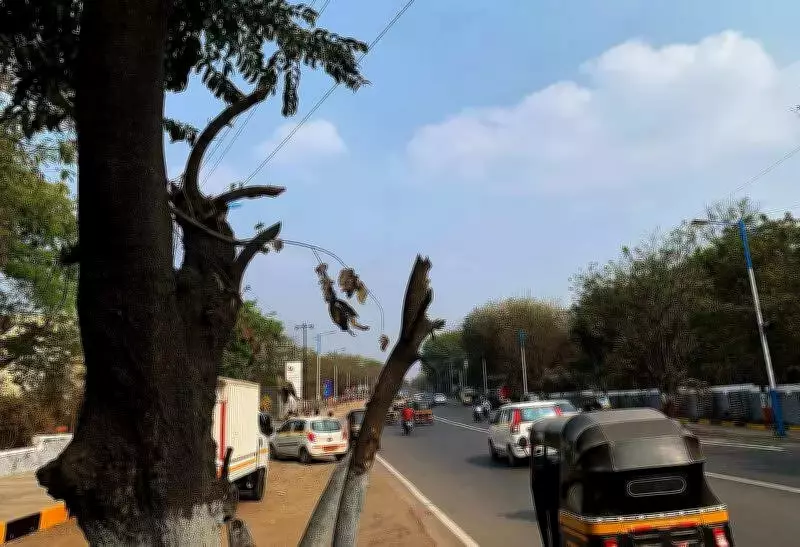
Pune's Green Cover Controversy: WRI Study Challenges Municipal Tree Data
Environmental activists and urban planning experts have raised serious concerns about the accuracy of Pune Municipal Corporation's Environment Status Report for 2023-24, particularly regarding its claim that the city houses over 55 lakh trees. The criticism follows similar doubts expressed about PMC's 2019 tree census, which listed more than 40 lakh trees within civic limits.
Independent Research Reveals Significant Discrepancies
A comprehensive review conducted by four researchers from World Resources Institute India—Parth Sarathi Roy, Pulakesh Das, Sayantan Dey, and Kanchana Balasubramanian—has uncovered widespread disparities in PMC's tree census data. Their analysis, published in November 2024, utilized satellite imagery and machine learning algorithms to track changes in Pune's green cover between 2016 and 2019.
"We intended to verify the accuracy of PMC's data, but the loopholes were too numerous to ignore," explained Das, now serving as tech lead at Madhya Pradesh State Electronic Development Corporation Ltd. "Consequently, we conducted our own independent analysis using advanced technological methods."

Alarming Findings About Pune's Tree Loss
The WRI research team discovered that Pune actually lost approximately 620 hectares of tree cover and 500 hectares of grassland during the three-year period examined. Their study also revealed concerning patterns in the city's remaining tree population.
- Most surviving trees in Pune measure between 6 and 18 meters in height
- Older specimens exceeding 22 meters have become increasingly rare
- Historic neighborhoods like Camp, Koregaon Park, and Shivajinagar have experienced significant loss of large banyan and rain trees
"Taller trees with wider canopies have been disproportionately affected," noted Roy, senior fellow for sustainable landscapes and restoration at WRI. "This loss translates to reduced carbon storage capacity and increased carbon emissions from Pune's urban landscape."
Methodological Flaws in PMC's Data Collection
The WRI researchers conducted detailed verification by overlaying PMC's tree records on high-resolution Google Earth imagery. Their analysis revealed multiple inconsistencies:
- Data points appearing over built-up structures and residential buildings, particularly in Kharadi
- Unrealistically dense tree clustering in Wadgaonsheri with spacing less than 1 meter
- Significant discrepancies near IISER, Pashan, where PMC data showed 2,200 trees but ground verification found barely 100
Das suggested that outdated GPS equipment might have contributed to positional errors in PMC's data collection. "If PMC had conducted proper verification checks, they would have identified the same issues we discovered," he remarked.
PMC's Defense and Independent Expert Perspectives
PMC officials have defended their census methodology, insisting on the accuracy of their data. Yuvraj More, manager of PMC's garden department, explained that the corporation hired a private agency in 2016 to conduct the survey using GIS mapping and mobile-based data collection.
"Approximately 200 surveyors recorded detailed tree characteristics including species, height, canopy size, girth, and precise location coordinates," More stated. "Any discrepancies noted by researchers might reflect subsequent development at previously recorded geolocation points."
Independent experts have offered balanced perspectives on the controversy. Devdatta Tengshe, GIS professional and co-founder of Terra Helix Technologies, acknowledged that remote sensing provides valuable estimates but requires ground verification for precision.
"While WRI's study would benefit from additional ground verification, PMC's data clearly requires cleaning and validation," Tengshe observed, recalling instances where trees were recorded in locations where none existed.

Urban Development Patterns and Green Cover Distribution
Ecology expert Kedar Champhekar highlighted how Pune's urban development has affected tree distribution across different neighborhoods. Older residential areas including Deccan, Kothrud, Sahakarnagar, Karvenagar, Chinchwad, Nigdi, Model Colony, and Aundh have maintained better greenery because trees were integrated into their original layouts.
"Redevelopment projects are gradually reducing tree cover in these established areas," Champhekar explained. "Meanwhile, newer localities like Balewadi, Baner, Hinjewadi, and Ravet continue to have sparse vegetation."
He further cautioned that apparent increases in PMC's tree counts might simply reflect expanded city boundaries rather than actual growth in green cover. "The crucial metric is the proportion of green cover relative to total urban area," he emphasized.
Recommendations for Improved Urban Forestry Monitoring
Experts have proposed several strategies for enhancing Pune's tree census accuracy and urban forestry management:
- Data Verification: PMC should systematically verify existing data and identify error sources
- Hybrid Approach: Combine traditional ground surveys with modern technology including drones and high-resolution satellite imagery
- Public Participation: Engage citizens in data validation and make tree census information publicly accessible
- Technology Integration: Utilize platforms like Google Earth Engine, already employed in global urban forestry studies
Tengshe advocated for broader urban planning considerations: "We must fundamentally reconsider what type of development we want. The shade provided by trees along JM Road and FC Road demonstrates their practical value. Urban planning should consistently address both preserving existing trees and strategically planting new ones."
Comparative Methodologies: WRI vs. PMC Approaches
The WRI study employed sophisticated technological methods:
- Sentinel-1 Radar: Captured surface structure using microwave signals to identify tree canopies
- Sentinel-2 Optical/NIR: Tracked vegetation through visible and near-infrared imagery
- GEDI LiDAR: Measured canopy height using laser pulses from the International Space Station
- Random Forest Algorithm: Machine-learning model that classified land-use changes with 75% overall accuracy
In contrast, PMC's methodology relied on:
- Approximately 200 field staffers physically visiting and recording each tree
- Manual measurement of girth using tape
- Visual estimation of height and canopy size
- Location tagging through Google Maps coordinates on mobile devices
- Manual data verification before central database upload
Urgent Need for Improved Urban Environmental Monitoring
The findings underscore the critical importance of reassessing municipal methodologies for monitoring green cover in rapidly urbanizing environments. As Pune continues to expand, accurate environmental data becomes increasingly essential for addressing pressing concerns including deteriorating air quality, urban flooding, and climate resilience.
The divergence between satellite-based analysis and ground-based census data highlights the need for integrated approaches that combine technological innovation with systematic field verification. Only through such comprehensive methods can cities like Pune develop effective strategies for preserving and enhancing their urban forests amid continuing development pressures.