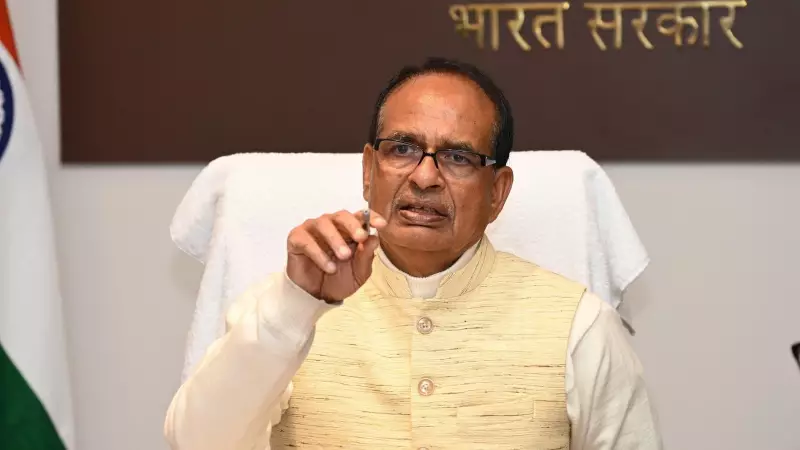
Union Minister for Agriculture and Farmers Welfare, Shivraj Singh Chouhan, announced on Thursday a significant national initiative. He stated his intention to replicate Punjab's successful model for reducing stubble burning across the rest of India. This declaration spotlights a remarkable environmental turnaround achieved after a decade of persistent effort.
The Multi-Pronged Strategy Behind the Success
For years, Punjab was identified as a primary contributor to severe air pollution in North India. The practice of burning paddy residue after harvest, coinciding with winter, drastically worsened air quality in the National Capital Region. Satellite imagery from NASA and stern observations from the National Green Tribunal (NGT) and the Supreme Court underscored the crisis. The turning point began with accurate monitoring. In 2016, the Punjab Remote Sensing Centre (PRSC) initiated satellite surveillance, revealing a staggering 80,879 farm fires that year.
The state's response was a comprehensive, multi-stakeholder approach. The cornerstone was the Crop Residue Management (CRM) programme launched in 2018-19. This scheme provided financial subsidies—50% for individual farmers and 80% for groups—to purchase machinery like Happy Seeders, Mulchers, and Super SMS machines. Jaswant Singh, Director of Punjab Agriculture, noted that adoption was slow initially but accelerated as the government ramped up distribution. From around 25,000 machines in 2018-19, Punjab has now distributed over 1.48 lakh CRM machines, including 66,000 Super Seeders.

From FIRs to a Circular Economy
Alongside incentives came enforcement and awareness. This year alone, 1,963 FIRs were registered against violators, and the threat of "red entry" in land records acted as a deterrent. Simultaneously, intense campaigns educated farmers on the long-term damage of burning to soil health. A critical shift occurred among farmers' unions, which once supported the practice but have now largely fallen silent on the issue.
The strategy evolved beyond in-situ management (mixing straw into soil) to ex-situ solutions, creating a circular economy. Jagdish Singh, Joint Director and Nodal officer for the CRM Programme, revealed that this year, 7.50 million tonnes of stubble was collected for industrial use in biomass power plants, paper mills, and as fodder. This network, initially limited to border districts, has expanded to areas like Gurdaspur, Patiala, and Jalandhar. The establishment of plants like the CBG unit in Lehragaga, Sangrur, has led to a visible drop in fires within a 4-5 km radius.
The Results and the Road Ahead
The data speaks to the model's efficacy. After a second-high of 76,929 fires in 2020, the numbers have plummeted. For the current year, Punjab recorded only 5,114 farm fires, a 53% decrease from 2024 and a reduction of approximately 94% from the peak. Punjab's Agriculture Minister, Gurmeet Singh Khuddian, attributed this success to teamwork and a changed farmer mindset. He emphasized that the focus has moved beyond just providing machines to building an ecosystem where farmers understand the benefits for their soil's long-term productivity.
Jaswant Singh highlighted the coordinated role of district administrations, the police, the Pollution Control Board, and the Agriculture Department. The next phase, as outlined by officials, involves deepening these gains by ensuring CRM machinery reaches every corner of the state and focusing on further improving soil health. As Union Minister Chouhan prepares to scale this model, Punjab's decade-long struggle offers a proven blueprint for tackling one of North India's most persistent environmental challenges.