

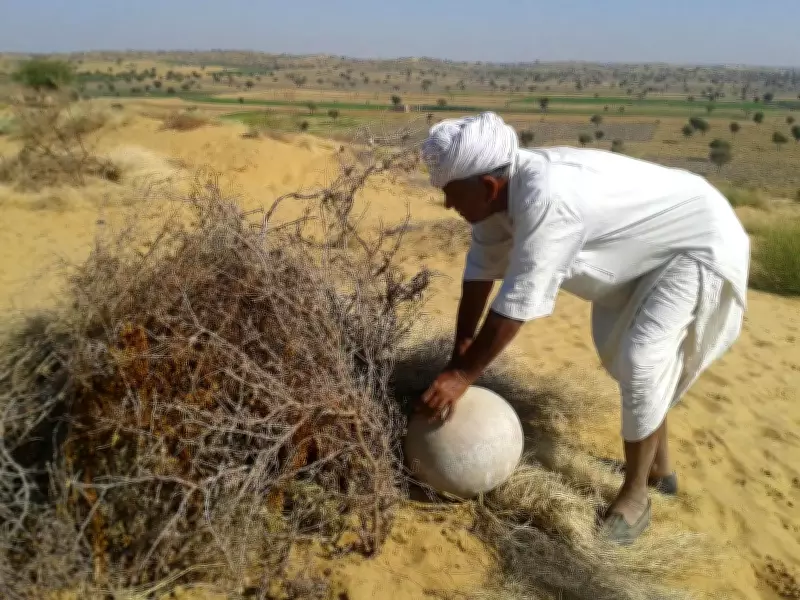
Rajasthan Farmer's 27,000 Trees Turn Desert into Green Oasis
The story of Ranaram Bishnoi from Ekalkhori village near Jodhpur in Rajasthan sounds almost mythical at first glance. In a region where shifting sands often threaten to engulf farmland, this determined farmer has achieved the improbable: halting the desert's advance and transforming barren dunes into a thriving green garden through sheer perseverance and ecological wisdom.
Decades of Dedication Against Desertification
Over many years, Ranaram Bishnoi is widely reported to have planted approximately 27,000 trees across roughly 25 bigha, equivalent to about 10 acres of desert land. His method was remarkably simple yet grueling: he carried water by hand from a nearby well or tubewell, often using an earthen pot on his shoulder, and walked nearly three kilometers each day to water the saplings. This was not a short-term project but a lifelong commitment, involving repetitive efforts and unwavering dedication to reclaim land that many had written off as hopeless.
Strategic Planting with Indigenous Species
Ranaram's approach was not haphazard; he carefully selected hardy indigenous trees suited to arid conditions, including neem, rohida, kankeri, khejri, fig, babool, and bougainvillea. This choice reflects deep ecological intelligence, working with the desert's natural logic rather than against it. To protect the young saplings, he used thorny fencing to deter cattle and wildlife, ensuring their survival in a harsh environment. His work exemplifies how environmental restoration can be built from daily acts of care, allowing roots to establish where wind once dominated.

Rooted in Bishnoi Conservation Traditions
This achievement is deeply embedded in the cultural and environmental heritage of the Bishnoi community, long known for conservation efforts in Rajasthan. Ranaram's actions align with a historical tradition that includes the 1730 sacrifice, which has inspired India's environmental movements. In this context, planting trees is not just a practical defense against desertification but a cultural inheritance, where nature is treated as kin rather than mere scenery. This background enriches his personal story, showing how community values can drive sustainable change.
Lessons in Environmental Stewardship
Ranaram Bishnoi's tale endures because it transcends individual heroism, illustrating how land protection can become a habitual practice rather than a fleeting slogan. The transformation in Ekalkhori did not occur through grand policies alone but through consistent, hands-on effort—water, saplings, and patience applied day after day. It serves as a powerful reminder that environmental repair often starts at the grassroots, with individuals who believe even the most hostile landscapes can be nurtured back to life. In Rajasthan's shifting sands, this belief has truly taken root, offering hope and inspiration for conservation efforts worldwide.






