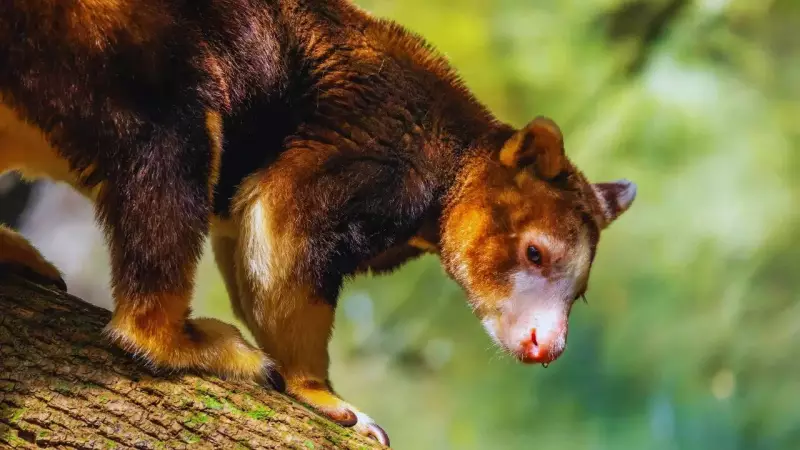
In a stunning turn of events that reads like a script from a wildlife documentary, one of the world's rarest marsupials has emerged from the shadows of presumed extinction. The Wondiwoi tree kangaroo, last seen by scientists nearly nine decades ago, has been confirmed alive in the remote, mist-shrouded mountains of West Papua, Indonesia. This remarkable rediscovery offers a powerful message of hope for conservationists and underscores the enduring mysteries hidden within Earth's last wild frontiers.
The Lost and Found Marsupial: A 90-Year Mystery
The story of this elusive creature begins in 1928, when the celebrated biologist Ernst Mayr first documented the species during an expedition in the rugged Wondiwoi Mountains on New Guinea's Vogelkop Peninsula. Mayr's account was unique; he described an animal that defied the typical kangaroo image. It resembled, he noted, an unusual cross between a monkey and a bear, and it lived not on the ground but high in the forest canopy. After that single, fleeting encounter, the Wondiwoi tree kangaroo vanished.
For 90 years, there was no trace. No sightings, no photographs—only a single preserved museum specimen. The scientific community gradually began to fear the worst. Given the rampant habitat loss and the species' suspected extremely limited range, many believed it had quietly slipped into extinction, becoming just another footnote in the tragic annals of biodiversity loss.

The 2018 Expedition That Changed Everything
The narrative took a dramatic turn in 2018. An amateur botanist named Michael Smit led a team into the heart of the isolated Wondiwoi Mountains, a region with steep terrain, dense tropical forests, and virtually no human access. Their goal was to study the poorly documented flora and fauna. To capture evidence of wildlife, the team strategically placed motion-sensitive camera traps across forested slopes at high altitudes.
The effort paid off spectacularly. The camera traps captured clear images of a large, tree-dwelling marsupial moving gracefully through the canopy. Expert analysis later confirmed the incredible truth: this was the Wondiwoi tree kangaroo, alive and well. The photographs represented the first confirmed sighting and the first-ever photographic evidence of the species in the wild since Mayr's encounter. The animal was no longer a near-mythical relic but a living, breathing resident of the Papuan rainforest.
What This Rediscovery Means for Conservation
The rediscovery site, located at elevations between 4,900 and 5,600 feet, reveals the species' preference for cool, montane rainforest habitats. The Wondiwoi tree kangaroo is one of only about 17 known tree-dwelling kangaroo species, a group that has evolved powerful forelimbs, long claws, and flexible joints for an arboreal life. Its survival in such an inaccessible location is likely the very reason it remained hidden for so long.
This event has significant implications:
It reignites hope for other "lost" species. If a creature can remain undetected for a century in a remote pocket of forest, it suggests other species thought extinct might still be clinging to survival in overlooked sanctuaries.
It underscores the critical need to protect isolated habitats. The Wondiwoi Mountains, already an ecologically valuable area, now gain prominence as a confirmed biodiversity hotspot. This rediscovery strengthens the case for their long-term and robust protection from logging, mining, and other human encroachments.
It also comes with a caution. Scientists warn that species with such tiny, restricted ranges are exceptionally vulnerable. Any change—be it deforestation, climate shift, or even increased human activity—could have a devastating and irreversible impact on their small populations.
The rediscovery of the Wondiwoi tree kangaroo is a potent reminder of nature's resilience and the vast unknowns still waiting to be discovered. Once known only from a dusty museum specimen, it has now reclaimed its place among the living, silently leaping through the treetops of New Guinea, unseen but finally, unforgotten.