

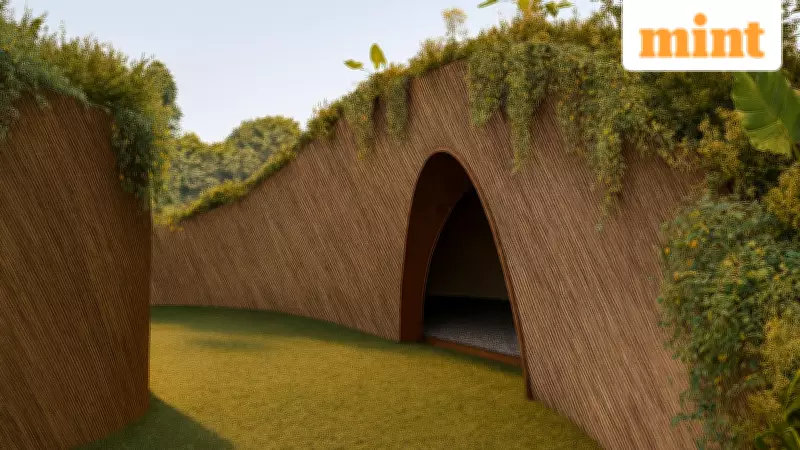
Sacred Nature Pavilion Emerges as a Green Oasis in Delhi's Sunder Nursery
Amidst the bustling traffic of Delhi, a serene spiral structure comes into view at Sunder Nursery, marking a stark contrast to the urban chaos. This heritage neighborhood now hosts Sacred Nature, a pavilion designed to evoke the essence of ancient sacred groves, seamlessly blending architecture with conservation efforts. The initiative is the brainchild of Aranyani, a conservation and creative arts project led by environmentalist Tara Lal, in collaboration with T__M.space, an international architectural studio known for its ecological ethos.
Bridging Urban and Natural Worlds Through Design
For Tara Lal, Sacred Nature represents a deliberate attempt to close the gap between city life and the natural environment. She observes that urban living often conditions people to view forests as distant destinations rather than integral relationships. By situating this forest-like intervention in the heart of Delhi, Lal aims to challenge and reverse this perception. "The pavilion isn't just a representation of nature or a didactic display about ecology. It's a living, sensory environment. You step out of the city's linear pace into a slower, cyclical one," she explains, highlighting the immersive experience it offers.
The pavilion covers approximately 600 square metres in total area, with an inner built space of around 250 square metres. Its canopy is adorned with indigenous plants such as jasmine, neem, tulsi, and bakul, resting on a textured outer shell crafted from repurposed lantana wood. This choice of material is both practical and symbolic, addressing ecological issues while telling a historical story.

Lantana Wood: A Material of Metaphor and Repair
The use of lantana in Sacred Nature's structure operates on multiple levels. Originally introduced by the British for aesthetic purposes, lantana has become an aggressive invasive species, spreading rapidly across forests and grasslands, displacing native flora and altering soil chemistry. Today, it poses a persistent ecological challenge, requiring significant effort for removal. Its presence serves as a poignant reminder of colonial impacts on the land.
Lal emphasizes a conservation philosophy centered on repair and reuse rather than extraction. "Rather than extracting fresh resources to build the pavilion, we chose to work with lantana that has already been cleared. In that sense, the structure is made from the by-products of ecological damage. This approach to conservation is about repair and reuse rather than extraction," she states. By transforming lantana into a contemplative and sacred space, the pavilion invites reflection on this history without erasing it.
Architectural Features and Public Programming
Sacred Nature's design is intentionally modular, allowing for dismantling and reassembly to facilitate movement across different landscapes. After its debut at Sunder Nursery, the pavilion is slated to relocate to the Rajkumari Ratnavati Girls' School in Jaisalmer, where it will serve as an educational space for students and support training for young naturalists.
The spiral form of the pavilion influences visitor movement and pace, with a central shrine acting as a spatial anchor that encourages slowing down and focused attention. "At the centre sits a shrine that functions as a spatial anchor, a place where movement slows and attention gathers. This pause is intentional. It creates a moment of inward focus before conversation begins," Lal notes. This architectural intent extends to the public programming, which includes talks and conversations rather than formal lectures, bringing together diverse voices from art, conservation, history, and architecture.
Notable participants in the programming include environmental activist Vandana Shiva, who will discuss biodiversity and food sovereignty, historian Sathnam Sanghera exploring imperial legacies, and architects like Martand Khosla and Shonan Purie Trehan, whose work intersects ecology and design. Through these engagements, Aranyani fosters an evolving ecosystem that adapts to climate, context, and community needs.

A Vision for Sustainable and Adaptive Conservation
Sacred Nature stands as a testament to innovative conservation practices that prioritize sustainability and community engagement. By repurposing invasive species like lantana and creating a movable, modular structure, the project demonstrates how architecture can contribute to ecological repair and cultural dialogue. Lal concludes, "In this way, Aranyani is an evolving ecosystem, one that adapts and gives back while remaining responsive to climate, context, and community," underscoring the pavilion's role as a dynamic force in promoting environmental awareness and action.





