

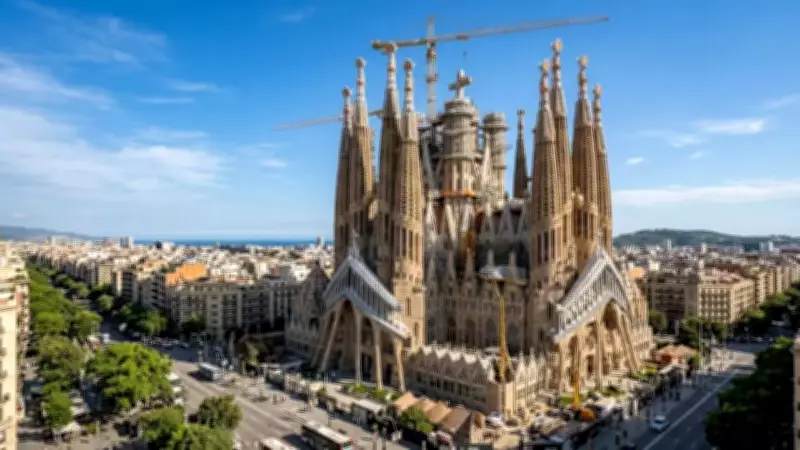
Sagrada Familia: A Monument of Perseverance and Innovation
For more than a century, the Basílica i Temple Expiatori de la Sagrada Família has stood as a powerful testament to architectural ambition and spiritual devotion. Since its foundation stone was laid in 1882, this iconic structure has dominated Barcelona's skyline, enduring numerous challenges including civil wars, the tragic death of its visionary architect Antoni Gaudí, and the loss of many original plaster models and workshop archives during its long construction journey.
From Gothic Origins to Gaudí's Masterpiece
Originally conceived as a simple Gothic-style cathedral by architect Francisco de Paula del Villar, construction on the Sagrada Familia commenced in 1882. However, in 1883, Antoni Gaudí assumed control of the project and transformed it radically. He blended Gothic elements with nature-inspired curvilinear designs characteristic of Art Nouveau, creating a unique architectural synthesis. Following Gaudí's death in 1926 and the destruction of many original models during the Spanish Civil War in 1936, the project evolved into a multi-generational restoration effort, relying on archived records to piece together Gaudí's original intent.
Modern Technology Realizing Gaudí's Mathematical Vision
Today's engineers employ advanced parametric design and computational engineering to bring Gaudí's complex forms to life. These structures feature double-curved ruled surfaces, utilizing geometric shapes like hyperboloids and parabolas instead of traditional right-angle construction. To manage this complexity, the design team utilizes Rhino 3D software and aeronautical engineering tools to simulate environmental forces such as wind and earthquakes. Since 2001, 3D printing has been instrumental in recreating damaged plaster models, allowing architects to visualize intricate details like the "silly, twisted towers" with precision unattainable by manual methods.

The Road to 2026: Symbolic Completion and Future Work
The year 2026 marks a pivotal milestone as the target completion date for the Tower of Jesus Christ, which will soar to 172.5 meters, making the Sagrada Familia the world's tallest church. This date holds profound significance as it coincides with the centenary of Antoni Gaudí's passing. While the main structure is expected to be finished by 2026, additional elements such as the iconographic programs, sculptural narratives, and the Glory Façade may require another decade to complete, ensuring the project's legacy continues to evolve.
Gaudí's Vision: Transcending Religious Boundaries
Gaudí's design philosophy was rooted in the belief that human creations should never surpass the beauty of nature, reflecting a deep spiritual connection. The interior naves resemble a stone forest, with branching columns supporting hyperboloid vaults and geometric diaphragms. This unique environment, recognized as a UNESCO World Heritage Site, showcases Gaudí's masterful use of light and complex mathematics to create a space that embodies the spiritual essence of the location. It continues to attract millions of visitors worldwide, regardless of their religious beliefs, highlighting its universal appeal.
Funding and Symbolism: As an expiatory temple, the Sagrada Familia is entirely funded by private donations and visitor revenues, without government or Church support. This financial model underscores its community-driven nature. The transition from 19th-century craftsmanship to 21st-century technologies like 3D printing symbolizes a historical bridge between traditional and contemporary artistic techniques, making its impending completion a momentous event in architectural history.






