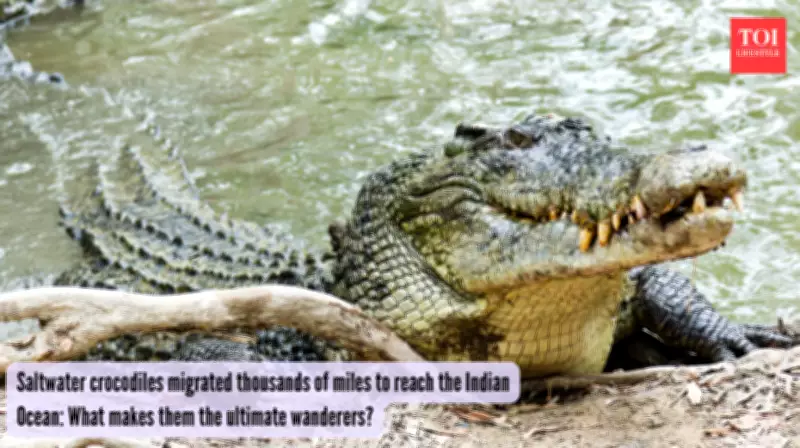
Saltwater Crocodiles: The Ultimate Ocean Wanderers
Saltwater crocodiles are truly massive creatures, often growing longer than a standard bus and weighing more than an average car. These formidable predators are known for their eerie appearance and deadly capabilities, making them some of the most feared animals worldwide. However, recent scientific discoveries have revealed an astonishing new dimension to their behavior: they are exceptional long-distance swimmers and settlers.
Ancient Migration Patterns Revealed
A groundbreaking genetic study has uncovered that saltwater crocodiles once migrated thousands of miles across the Indian Ocean. Early explorers documented crocodile sightings along the Seychelles coastline approximately 250 years ago, but these creatures mysteriously vanished by 1820. This disappearance occurred roughly 50 years after human settlers arrived in the region in 1770.
Researchers from Germany and Seychelles combined modern DNA analysis with examination of ancient museum skulls to solve this historical mystery. Their findings, published in Royal Society Open Science, confirm that these vanished crocodiles were not a unique species but rather the westernmost population of saltwater crocodiles.

Remarkable Ocean Survival Mechanisms
What enables these massive reptiles to survive in salty ocean environments? Saltwater crocodiles possess specialized salt glands that efficiently expel excess salt from their bodies. This biological adaptation allows them to tolerate seawater for extended periods, sometimes weeks at a time, unlike other crocodile species.
First author Stefanie Agne from the University of Potsdam explains the significance of their findings: "The genetic patterns suggest that saltwater crocodile populations remained connected over long periods and across great distances, pointing to the high mobility of this species."
Incredible Drifting Distances
Senior author Frank Glaw from the Bavarian State Collections provides astonishing details about their migration capabilities: "The founders of the Seychelles population must have drifted at least 3,000 kilometres across the Indian Ocean to reach the remote archipelago, perhaps even much further."
These six-meter-long, ton-heavy beasts once inhabited coastal regions spanning from Vanuatu in the Pacific Ocean to the Seychelles in the Indian Ocean—a distance exceeding 12,000 kilometers—before their extinction in the Seychelles.
Genetic Connections and Conservation Implications
The study examined three historic Seychelles museum skulls using ancient DNA techniques, conclusively proving they were distant cousins of contemporary saltwater crocodiles rather than a separate species. This genetic connectivity demonstrates ongoing movement across ocean basins, confirming saltwater crocodiles as the world's most widespread reptile species.
Human activity rapidly eliminated the Seychelles crocodile population, but modern genetic science has resurrected their remarkable story. This wandering ability explains their presence across vast geographical regions and has important implications for conservation efforts.
Future Research and Protection Needs
As climate change alters ocean currents and patterns, future research may track how modern crocodiles navigate changing marine environments. These findings highlight the urgent need for comprehensive conservation strategies and protected coastal habitats to ensure the survival of these extraordinary ocean wanderers.
The study underscores how saltwater crocodiles have mastered ocean travel through biological adaptations and remarkable endurance, earning their status as nature's ultimate wanderers capable of crossing entire ocean basins to colonize distant shores.