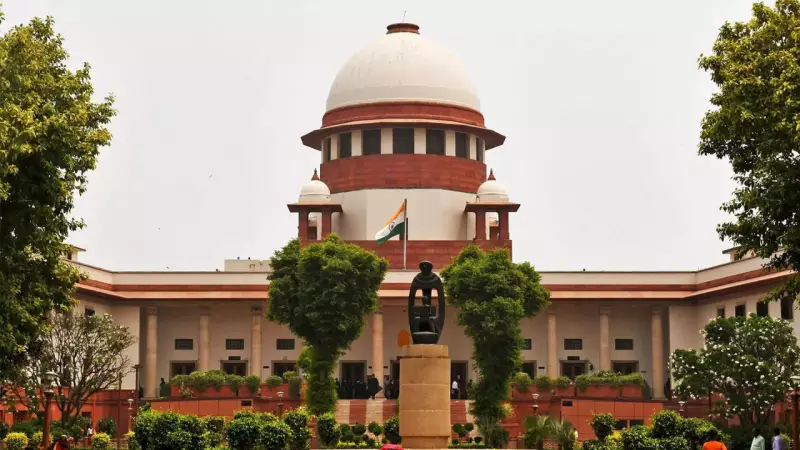
In a significant development for environmental governance, the Supreme Court of India has taken suo motu cognisance of the ongoing controversy surrounding the legal definition of the Aravali Range. This move sets the stage for fresh judicial scrutiny into an issue that has ignited public protests and intense debate over mining activities versus ecological conservation.
Court Hearing and the Core Controversy
A three-judge vacation bench, led by Chief Justice of India Surya Kant, is scheduled to hear the matter on Monday, as reported by news agency ANI. The court's intervention comes at a time of widespread concern over how the ancient Aravali hills are being delineated for regulatory purposes, especially concerning mining permissions.
The heart of the dispute lies in a height-based definition adopted by the Supreme Court on November 20 for making mining-related decisions. This definition classifies a hill as a landform rising 100 metres or more from the lowest enclosing contour, with nearby hills within a 500-metre radius grouped as a range. Environmental activists and civil society groups have raised strong objections, arguing that this technical criterion could drastically shrink the area officially recognised as part of the Aravalis, as significant portions of this ancient mountain system are low-lying. They fear this could potentially weaken long-standing conservation safeguards.

Government's Response and Expanded Mining Ban
Amidst this judicial and public scrutiny, the Union Environment Ministry has proactively moved to address conservation concerns. The ministry has decided to further expand the areas where mining will be prohibited across the entire Aravali range. It has directed the Indian Council of Forestry Research and Education (ICFRE) to identify additional landforms and ecological zones that should be brought under the mining ban, over and above the regions already restricted.
In an official communication, the ministry stated this exercise aims to "further enlarge the coverage of areas protected and prohibited from mining in the entire Aravalis, keeping in mind the local topography, ecology and biodiversity." Currently, only approximately 0.2 per cent of the Aravali's total expanse of around 1.4 lakh square kilometres is eligible for mining leases. The new identification process is expected to reduce this miniscule percentage even further.
Immediate Directives to States
In a crucial interim measure, the central government has instructed all states spanning the Aravali range—Haryana, Rajasthan, and Gujarat—not to grant any new mining leases until a comprehensive Management Plan for Sustainable Mining (MPSM) is finalised. This directive effectively puts a hold on fresh mining approvals in the sensitive region.
The Environment Ministry has, however, defended the 100-metre definition, maintaining that it does not dilute existing mining controls and that all current safeguards remain firmly in place. It has also clarified that for mines already operational, state governments bear the responsibility of ensuring strict compliance with environmental norms and Supreme Court orders.
The Supreme Court's suo motu action, combined with the central government's steps to widen the protection net, highlights the escalating national focus on preserving the fragile ecology of the Aravalis. The outcome of Monday's hearing and the final ICFRE report will be pivotal in shaping the future of conservation and regulated resource extraction in one of India's oldest mountain ranges.