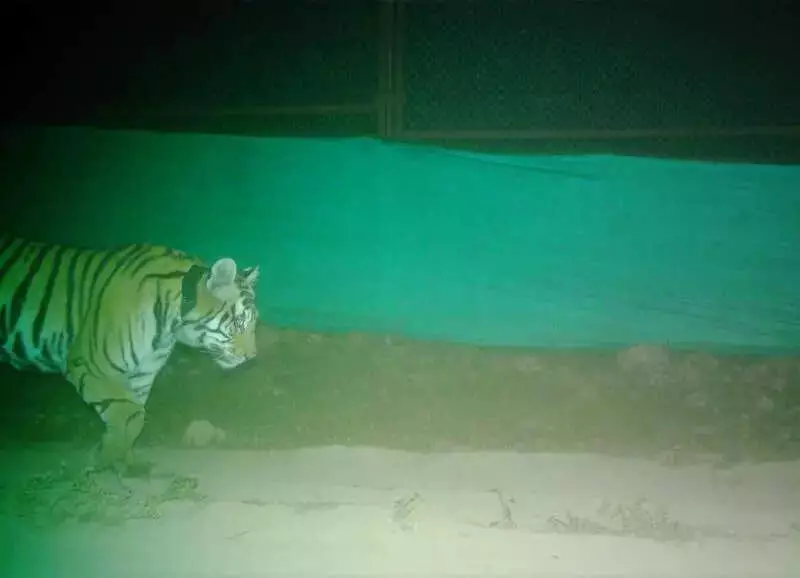
In a significant boost for wildlife conservation, Rajasthan's Ramgarh Vishdhari Tiger Reserve (RVTR) witnessed a crucial milestone this Sunday with the successful wild release of tigress PN-224. This event marks the completion of the second interstate tiger translocation project ever undertaken in India.
A Carefully Planned Release
The tigress, originally translocated from Pench Tiger Reserve in Madhya Pradesh, had been acclimatizing in a soft release enclosure at RVTR since December 22. Following protocol, the enclosure gates were opened on December 27. Demonstrating natural and confident behavior, PN-224 voluntarily ventured out and entered the forest at 3:36 AM on Sunday.
Sugna Ram Jat, the Kota forests and wildlife conservator and field director for Mukundra Hills Tiger Reserve (MHTR), confirmed the operation's success. "Tigress PN-224 voluntarily left the enclosure and entered the forest on Sunday, reflecting normal and confident behaviour," he stated, adding that the entire process adhered strictly to protocols set by the National Tiger Conservation Authority (NTCA).

Part of a Larger Conservation Strategy
This translocation is part of a major, approved plan by the NTCA and the Ministry of Environment, Forest and Climate Change (MoEF&CC) to relocate five tigresses from Madhya Pradesh to Rajasthan in two phases. The strategy aims to bolster tiger populations and ensure genetic diversity in Rajasthan's reserves.
The plan's phases are structured as follows:
- Phase One: Involves moving three tigresses from Kanha or Pench Tiger Reserves to RVTR.
- Phase Two: Will see two more tigresses shifted from Bandhavgarh or Pench in MP, and Tadoba in Maharashtra, initially to RVTR. One of these is later planned for relocation to Mukundra Hills Tiger Reserve (MHTR).
Additionally, a male tiger from Ranthambore is also slated for relocation to Mukundra as part of this broader process.
Monitoring and Reserve Population
Post-release, the forest department has initiated intensive surveillance of PN-224. "The tigress will be monitored continuously through radio telemetry, field tracking, and intensive surveillance," officials said. This 24/7 vigilance will help assess her movement, health, and adaptation to the new habitat while ensuring ecological balance and safety.
Arun Kumar D, deputy forest conservator at RVTR in Bundi, provided an update on the reserve's big cat count. "The reserve currently has a total of eight big cats. These include two adult males, one male cub aged nearly 12 months, and five tigresses, including the newly relocated one," he explained. The newly arrived tigress will soon be officially designated as RVT-9.
This success story follows other recent conservation actions at Ramgarh. In August 2023, a tigress (RVT-3) from Ranthambore was introduced and has recently given birth to cubs. Last month, a tiger from Sariska that wandered into Haryana was relocated to Ramgarh as RVT-4. A male tiger from the first rewilding project was also released here earlier this month.
The successful release of PN-224 stands in contrast to an earlier, unsuccessful attempt in 2018 to move tigers from Kanha in MP to Satkosia in Odisha. It represents a hopeful step forward for India's ambitious tiger conservation and population management efforts.