

Snakes' Incredible Survival Tactics: From Mimicry to Playing Dead
Unlike many animals that rely solely on brute force or venom, snakes have evolved a remarkable array of defensive strategies to thrive in their environments. These behaviors go beyond simple reflexes, showcasing snakes as sophisticated survivalists with thousands of years of evolutionary refinement. From the King Cobra's intimidating stance to the Hognose Snake's dramatic death feign, these tactics highlight a complex neurological capacity for threat assessment and deception.
Boa Constrictor: The Heart-Monitoring Predator
Research published in the Proceedings of the Royal Society B reveals that boa constrictors are far from indiscriminate killers. These snakes utilize hyper-sensitive bodies to monitor the heartbeats of their prey. By applying pressure based on cardiac activity, they continue constricting until no heartbeats are detected, ensuring efficient and precise predation.
Coral Snake Mimics: Masters of Deception
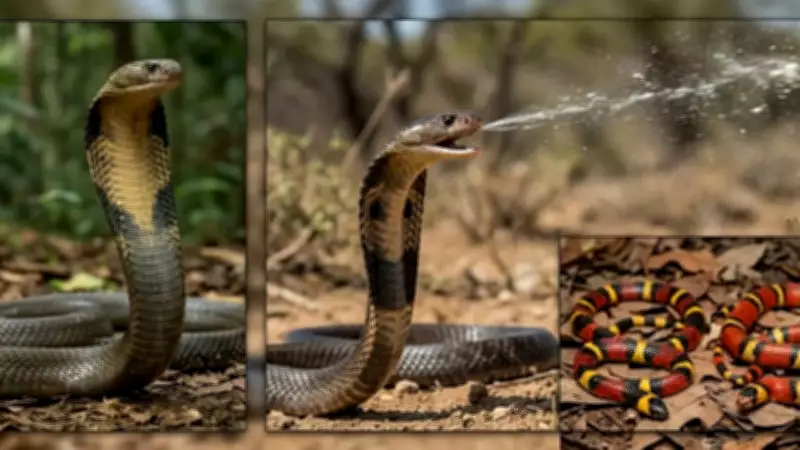
The Scarlet Kingsnake, a non-venomous species, employs Batesian mimicry by copying the warning coloration of the venomous Eastern Coral Snake. Predators in regions inhabited by coral snakes instinctively avoid the red-yellow pattern, granting the kingsnake a survival advantage without the need for actual venom.

King Cobra: The Intimidating Giant
As the world's longest snake, reaching up to 5.85 meters, the King Cobra has a unique defensive posture. According to the Smithsonian’s National Zoo & Conservation Biology Institute, it can elevate one-third of its body off the ground and expand its hood. Its venom contains post-synaptic neurotoxins that target the central nervous systems of large mammals, including humans and elephants, leading to respiratory failure and death.
Rattlesnake: Thermal Vision Expert
Rattlesnakes possess a specialized organ called a loreal pit, enabling them to detect infrared radiation. Research from the National Institute of Biomedical Imaging and Bioengineering indicates they can sense temperature differences as minute as 0.003 degrees Celsius. This thermal vision allows them to identify warm-blooded predators long before visual detection, providing a critical early-warning system.
Spitting Cobra: Precision Striker
Spitting cobras have evolved forward-pointing fangs with specialized holes for venom delivery. Studies in the Journal of Experimental Biology show they track the eye movements of attackers, flicking their heads to create an ideal spray pattern. This tactic delivers toxins to the cornea, causing immediate pain and temporary blindness, facilitating escape.
Hognose Snake: The Death Feigner
The Hognose snake is renowned for thanatosis, or feigning death. Research in the Journal of Herpetology details a multi-stage defense: first flattening its head to mimic a cobra, then rolling onto its back with an open mouth. If further threatened, it may rupture capillaries to bleed from the mouth, simulating a decaying carcass and deterring predators.
These adaptive behaviors underscore snakes' creativity and neurological sophistication, ensuring their survival across diverse ecosystems through mimicry, sensory enhancements, and elaborate decoys.






