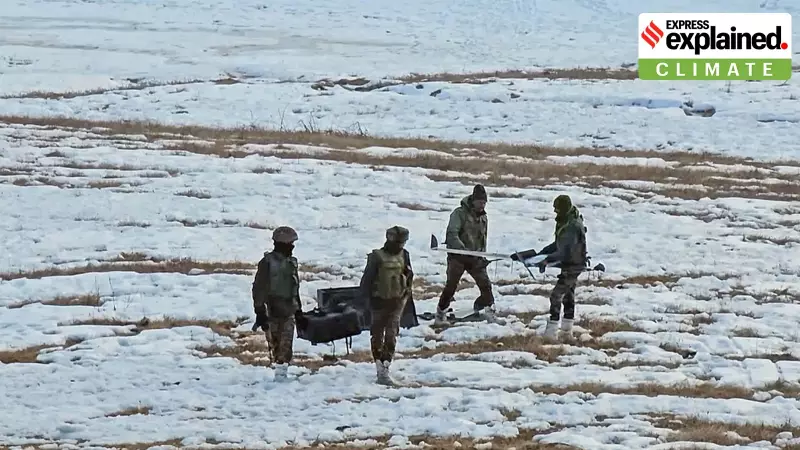
Himalayan States Face Unprecedented Dry Winter
This winter has brought an unusual sight to the Himalayan region. Mountain peaks across Uttarakhand, Himachal Pradesh, and Jammu & Kashmir remain strikingly bare and snowless. According to data from the India Meteorological Department, these states have received minimal precipitation during December and January.
Alarming Rainfall Deficits Recorded
The numbers paint a concerning picture. Uttarakhand received no rainfall at all during December and January. Himachal Pradesh recorded its sixth-lowest December rainfall since 1901. Jammu & Kashmir saw very little rain and snow in January.
For the entire country, this has been a dry winter season. India received less than one-fourth of expected rainfall in the first half of January. However, the northwest region suffered particularly severely, getting just 8 percent of anticipated rainfall during this period.

Experts Note Growing Dry Trend
Meteorologists observe that winters in Himalayan states have been getting progressively drier over the past decade. C S Tomar, IMD Dehradun director, highlighted this pattern. "During the last ten years, Uttarakhand has experienced very little January rainfall on four occasions. This indicates the trend is becoming common," Tomar explained.
The previous winter season of 2024-25 already showed worrying signs, with the northwestern region experiencing a 96 percent rainfall deficiency. Studies confirm a marginal declining trend in winter rainfall over certain parts of north India.
Why Western Disturbances Failed
Winter precipitation in north and northwest India typically comes from western disturbances. These weather systems normally interact with moisture from the Bay of Bengal or Arabian Sea, creating precipitation over the Himalayas.
This year, however, western disturbances lacked sufficient strength. Eight streams crossed northern India in December, compared to the normal six, yet produced minimal rainfall. Tomar detailed the technical reasons: "Current western disturbances carry little moisture. Their troughs are shallow, limiting moisture lifting capacity. Their northward propagation at higher latitudes explains why Kashmir and parts of Himachal received some precipitation, while Uttarakhand, lying eastward, did not."
Multiple Consequences Emerge
The dry conditions have triggered several concerning developments:
- Forest fires rage across Himalayan regions, particularly in the Valley of Flowers range within Nanda Devi National Park
- The Forest Survey of India recorded over 1,600 fire alerts in Uttarakhand since November 1
- Himachal Pradesh reported 600 fire alerts, Jammu & Kashmir around 300
- Reduced snow persistence threatens groundwater recharge and rabi crops
Long-Term Climate Concerns
Scientists warn about broader implications. Manish Mehta, a scientist at Wadia Institute of Himalayan Geology, expressed concern about glacial impacts. "Glaciers could melt earlier than seasonal patterns suggest. This may lead to proglacial and supraglacial lake formation, increasing flood risks. Equilibrium line altitude could shift upward, reducing river discharge volumes," Mehta explained.
The situation affects neighboring regions too. Nepal has also experienced a dry winter, compounding regional climate concerns.
Hope for Near Future
Some relief may arrive soon. The IMD forecasts light to moderate rainfall over northwestern India from January 18 to 20, driven by another approaching western disturbance. The meteorological department stated on Thursday that rainfall activity would likely be below normal nationally, except in the western Himalayan region and northwest India, where it could be near normal to above normal.
Despite this potential respite, the broader trend remains worrying. The combination of declining snow persistence, reduced winter precipitation, and existing glacial mass loss creates a complex environmental challenge for Himalayan states and the communities depending on their water resources.