The Sundarbans, India's largest mangrove ecosystem and a natural barrier protecting coastal Bengal and Kolkata from Bay of Bengal storms, faces immediate climate threats that could jeopardize its unique biodiversity and local populations, according to a new report by Azim Premji University.
Climate Crisis Becomes Hyper-Local Reality
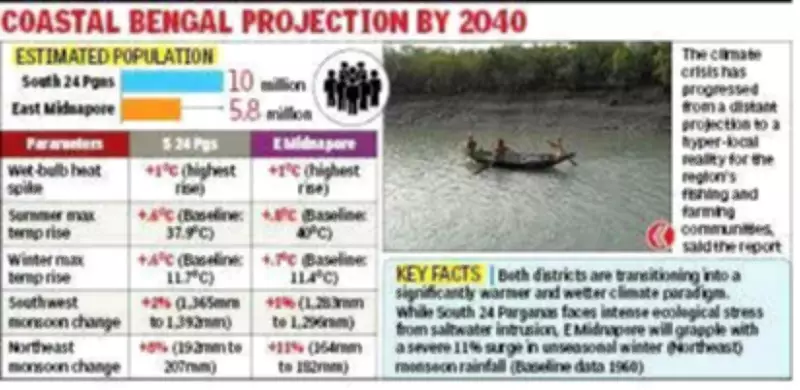
The study, titled 'Indian Coastal Region: Climate Projections 2021-2040', confirms that changing tidal patterns, rising sea levels, and accelerating salinity levels are already destabilizing the fragile delta ecosystem. The climate crisis has progressed from a distant projection to a hyper-local reality for fishing and farming communities in the region.
Using high-resolution data, the report maps near-term climate shifts and reveals that the 1.5°C global warming threshold is rapidly closing in on India's 11,000-km coastline. In South 24 Parganas district, summer wet-bulb temperature—a lethal metric combining heat and humidity—is projected to spike by 1°C. Annual maximums and winter minimums are climbing steadily by 0.6°C.

Urgent Need for Infrastructure and Governance Restructuring
Anurag Behar, CEO of Azim Premji Foundation, emphasized the urgency: '2040 is just 14 years away. This dataset brings to life the impacts of climate change with much greater immediacy, highlighting how we must restructure our infrastructure and governance to ensure we collectively address this crisis.'
Warming seas are accelerating tropical cyclone risks, and monsoons are deviating from their ancient rhythms. The Southwest monsoon is projected to swell, while the Northeast monsoon will surge by 8%. This excess water brings destruction rather than life. 'Frequent storm surges rip through our earthen embankments, pushing saltwater deep into agricultural lands and drinking wells,' Behar added.
Impact on Livelihoods and Health
Rising salinity leaves a bitter trail. Fishermen often return with empty nets as fish flee to deeper, cooler waters. Women, who bathe daily in brackish waters to gather wood or fish, suffer from chronic skin diseases and severe reproductive health challenges, the study notes.
Harini Nagendra, director at the university's School of Climate Change and Sustainability, warns that the crisis is hyper-local and immediate. As mudflats erode and 'ghost villages' loom across India's coastline, the window to adapt is narrowing. A villager stated: 'We have less than 14 years until 2040. I am fighting for my survival, and with me, the lives of 10 million people who call my delta home.'