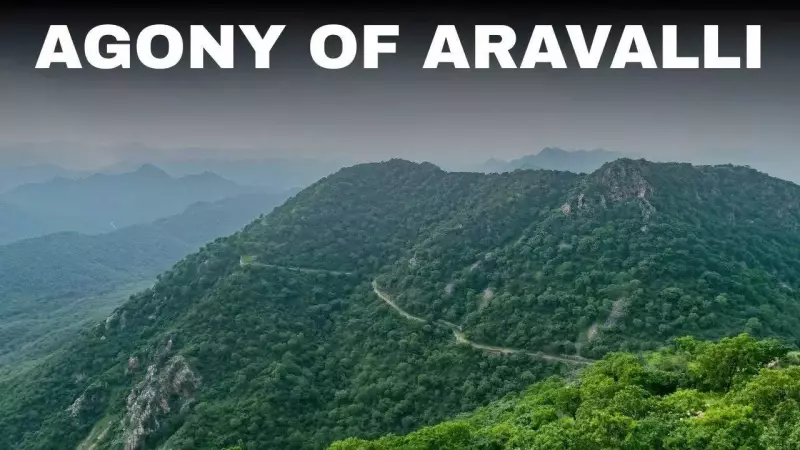
In a landmark decision with far-reaching ecological consequences, the Supreme Court of India has accepted a standardized definition to identify the Aravalli Range. The move, intended to resolve decades of legal ambiguity, has ignited a fresh debate between the imperatives of regulatory clarity and comprehensive environmental conservation.
The New Definition and Its Implications
In November, the Supreme Court agreed with a proposal from the central government to define the Aravalli Hills for regulatory purposes. The court ruled that only hills rising at least 100 metres above the surrounding land, or clusters of such hills, would be officially considered part of the Aravalli range. This elevation-based criterion is designed to provide a measurable threshold to end disputes over land classification that have plagued the region for years.
The apex court also directed the Union government to undertake a detailed mapping of the region and formulate a comprehensive management plan. This plan will explicitly outline where mining can occur and under what regulations. The objective is to eliminate the confusion stemming from contradictory government records and maps, which have frequently resulted in prolonged litigation.

Why the Aravallis Are Ecologically Indispensable
Environmental scientists and conservationists argue that the significance of the Aravallis cannot be reduced to a mere height parameter. Spanning nearly 690 km from Gujarat through Rajasthan and Haryana to Delhi, this ancient fold mountain system performs critical ecological functions.
Firstly, it acts as a natural water recharge system. The rocky terrain allows rainwater to percolate slowly underground, replenishing aquifers that supply water to numerous towns in Rajasthan and major cities like Delhi, Gurugram, Faridabad, and Alwar. Large-scale mining disrupts this vital hydrological process, leading to irreversible groundwater loss.
Secondly, the range serves as a crucial barrier, slowing the eastward march of the Thar Desert. Degradation of the hills could accelerate desertification, increasing dust storms and extreme heat in the fertile Indo-Gangetic plains.
Despite the arid climate, the Aravallis support diverse forests, scrublands, and grasslands, providing habitat for leopards, hyenas, nilgai, and numerous bird species. These fragile ecosystems are highly vulnerable to fragmentation from mining and construction activities.
Criticism and the Road Ahead
The Supreme Court's ruling has faced strong criticism from ecologists, hydrologists, and civil society groups. They contend that the 100-meter threshold is an oversimplification of a complex landscape. Many ecologically vital features—such as water recharge zones, wildlife corridors, and low-lying ridges—may not meet the elevation criteria but are integral to the range's overall environmental health. Excluding them from automatic protection could pave the way for expanded mining and real estate development.
Environmentalist Vimlendu Jha emphasized the holistic value of the range, stating, "Aravalli, which is the oldest mountain range in the world, is also an ecosystem." He warned that lifting protections could lead to "large-scale plundering" not just by mining, but also by other commercial sectors like real estate, jeopardizing the region's air quality, water sufficiency, and role as a climatic shield between the Thar Desert and Delhi.
The focus now shifts to the scientific mapping exercise mandated by the court. Environmental advocates stress that for this process to be meaningful, it must incorporate hydrology, biodiversity, and geomorphology, not just topography. They demand transparency, public access to maps, and independent scientific review to ensure the exercise aids genuine conservation and not just procedural formality.
The Aravalli debate encapsulates a broader national challenge: balancing developmental pressures with the protection of natural systems that defy simple administrative or numerical boundaries. As climate stress and water scarcity intensify in northwestern India, the implementation of this ruling will determine whether regulatory clarity strengthens or undermines the protection of this ancient, life-sustaining mountain range.