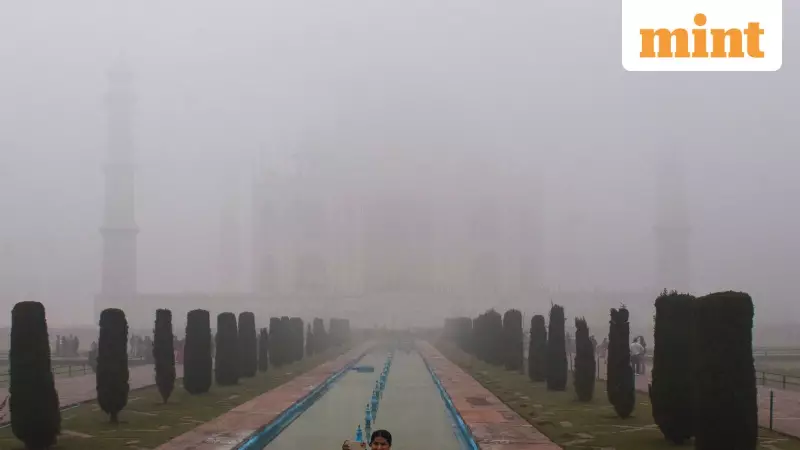
The iconic Taj Mahal, one of the world's most celebrated monuments, was nearly invisible on Sunday morning as a thick layer of smog and fog engulfed the city of Agra. The white marble marvel lost its sheen, shrouded by dangerously poor air quality and low visibility, presenting a grim picture of winter pollution in North India.
A Blanket of Smog Obscures the Monument
Visuals captured from the popular Taj View Point, managed by the Agra Development Authority (ADA), revealed a distressing scene. The majestic structure was almost completely hidden behind a dense blanket of haze. Visibility was severely reduced, fluctuating between a mere 50 and 200 metres, making it difficult for visitors and locals to catch a glimpse of the UNESCO World Heritage Site.
The primary culprit was the alarmingly poor air quality. Data from the Central Pollution Control Board (CPCB) recorded at 7:00 AM showed that the overall Air Quality Index (AQI) for Agra stood at 390. This placed the city firmly in the 'very poor' category, just 11 points shy of the highest 'severe' classification. Notably, several monitoring locations across Agra had already entered the 'severe' zone, indicating a widespread pollution crisis.

IMD's Fog Alert and Fluctuating Weather Conditions
The India Meteorological Department (IMD) had issued warnings for dense to very dense fog conditions in several parts of Uttar Pradesh, including Agra, during night and morning hours. The agency had even put out a red alert for Agra on Saturday, which was later downgraded to a yellow alert for Sunday.
While the air quality showed slight improvement by late morning, with the overall AQI reading 174 at 11:05 AM, the situation remained concerning. Five out of six monitoring stations reported 'moderate' air, but the station at Sanjay Palace recorded an AQI of 221, which falls in the 'poor' range.
The weather played a significant role in trapping pollutants. Agra recorded a minimum temperature of 16.6 degrees Celsius on Saturday. For December 21, the IMD forecast a minimum temperature around 10°C and a maximum near 15°C. The agency predicted fog or mist in the early morning hours until December 24. It also noted that the maximum temperature recorded on December 20 was 4.5 degrees below normal, while the minimum was 2.2 degrees higher than normal.
Widespread Fog Alert Across North and Central India
The IMD's warnings extended far beyond Agra. In a post on social media platform X, the agency cautioned about "Dense to very dense fog" during overnight and early morning hours across several North and Central Indian states, advising people to travel with caution due to reduced visibility.
The agency provided a detailed, region-wise breakdown of the fog alert:
- Uttarakhand, Uttar Pradesh, and Haryana: Alert in effect till the morning of December 21.
- Punjab and Haryana: Fog expected from December 25 to 27.
- West Uttar Pradesh: Alert for December 26 and 27.
- East Uttar Pradesh: Fog predicted on December 22, 26, and 27.
- Jharkhand: Alert for December 21 and 22.
- Madhya Pradesh: Conditions likely till the morning of December 21.
The disappearance of the Taj Mahal behind smog is a stark annual reminder of the twin challenges of winter pollution and fog that grip the Indo-Gangetic plains. It highlights the persistent environmental issues that not only affect public health but also obscure India's cultural crown jewel from view, impacting tourism and the local economy. The incident underscores the urgent need for sustained, region-wide efforts to improve air quality and mitigate the seasonal crisis.