

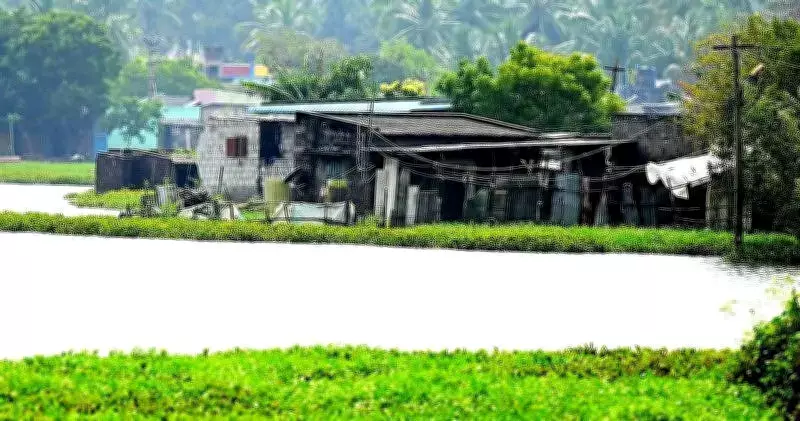
In Chennai's Tambaram region, residents queue up daily with buckets and cans, waiting for water lorries, even though five large water bodies lie not far from their homes. For decades, these lakes have not been used to supply water, and now it may be too late. The water bodies have shrunk by 44% over the years due to encroachments, pollution, and government apathy.
Water Supply Gap Widens
The Tambaram Corporation area requires about 130 million litres per day (MLD) of drinking water, but the civic body can supply only around 75 MLD. The promised 100 MLD from the Perur desalination plant could bridge this gap by March 2027. However, questions remain about where the excess of nearly 45 MLD will be stored and where pipelines will be laid to supply water to all localities. The corporation has only 49 overhead tanks, and no new reservoir has been built in the past five years. Corporation data shows that pipelines covering 1,091.3 kilometres reach only about 41% of residential areas. With rapid population growth, the gap between demand and infrastructure continues to widen.
Residents' Plight
C Murugaiyan, secretary of the Federation of Civic and Welfare Associations in Tambaram, said, "For at least six months in a year, we depend on water lorries. Despite paying a deposit of ₹10,000 as water tax, we are yet to get proper piped supply." Tambaram Corporation commissioner S Balachander stated that additional overhead tanks and sumps will be constructed, and 5 MLD will be sourced from the river Palar. "Once the Perur desalination plant is operational, water will be supplied through the Ring Main pipeline via Sembakkam, Nanmangalam, and East Tambaram," he said. "After restoration, water from lakes will be treated and supplied for potable use," he added.

State of the Five Water Bodies
Rajakilpakkam Lake
Near Camp Road, this lake has shrunk from about 105 acres to just 30 acres. It is polluted by inflow of untreated sewage, dumping of garbage, and water hyacinth covers most of its surface. At least 15 houses have been built inside the lake area, while meat and vegetable waste lines the bunds where pigs forage. A 2021 inspection by the Public Works Department identified around 960 illegal structures in and around the lake. Officials from the Water Resources Department (WRD), Tambaram Corporation, and CMDA said no funds have yet been allocated for restoration.
Nanmangalam Lake
Originally 200 acres, it has now shrunk to 120 acres. Large quantities of plastic, vegetable, and meat waste are routinely discarded along the Sembakkam side. Untreated sewage flows in through stormwater drains. Dense mats of water hyacinth cover significant portions of the lake. All 14 inlets feeding the lake are clogged with silt, plastic, and sewage. While the Nanmangalam panchayat side has been fenced to prevent dumping and encroachments, the Tambaram side remains heavily polluted. A detailed project report worth ₹70 crore has been prepared by WRD, but restoration work has not yet commenced.
Perungalathur Lake
Idumban Kulam, also known as Old Perungalathur Lake, has shrunk from 100 acres to around 55 acres because of encroachments and pollution. Officials estimate there are more than 600 illegal structures around the lake, which have blocked natural inflow channels. The water body is heavily polluted with untreated sewage and dense growth of water hyacinth. Tambaram Corporation has now allocated a budget of ₹6 crore to restore the lake.
Nemilichery Lake
Located near Chromepet, it has shrunk from 27 to 13 acres. The main inlet has been blocked, sewage inlets remain open, and the surplus outlet towards Keezhkattalai Lake has not been desilted, leading to stagnation of polluted water and accumulation of garbage. The northern side is worse, with dense hyacinth growth, heavy sewage contamination, and rampant dumping of household and meat waste. The ₹3.4 crore project initiated by CMDA remains incomplete.
Sembakkam Lake
Once spread across 150 acres, it has now shrunk to about 100 acres. The lake is choked with water hyacinth, and sewage inflow continues. Encroachments along the banks have further reduced its storage capacity. Despite ₹25 crore being allocated for restoration, there has been little visible progress on the ground.






