

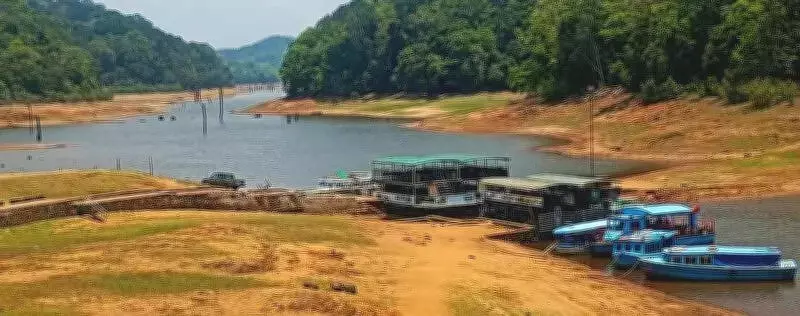
Thekkady Lake Faces Severe Drying Amid Intense Summer Heat
Idukki's Thekkady Lake, which serves as the crucial catchment area for the Mullaperiyar dam, is experiencing significant drying due to relentless summer temperatures. This environmental crisis has created a challenging situation for tourism and wildlife management in the region.
Boating Services Drastically Reduced
With water levels dropping precipitously, boats are now scraping against the exposed lakebed, prompting authorities to implement emergency measures. The forest department has reduced passenger capacity on all boats by approximately fifty percent as a safety precaution. Larger vessels that typically accommodate 120 passengers have been restricted to just 40-50 individuals, while smaller boats with capacities of 19-20 passengers have seen similar reductions.
The current water level at Mullaperiyar dam stands at 109 feet, dangerously close to the 108-foot threshold that would trigger complete suspension of all boating activities in Thekkady Lake. Since last Friday, only limited numbers of tourists have been permitted for boating excursions.

Tourist Access Modified
Despite the restrictions, visitors can still access the boat landing area by purchasing a Rs 75 ticket and utilizing forest department transportation. Thousands of tourists arriving after the Vishu festival have missed the boating experience, though many find consolation in being able to view the lake from the landing point.
The boating operations at Thekkady are jointly managed by the forest and tourism departments, utilizing major vessels including Vanajyotsna, Vanadarshan, Vanalakshmi, Periyar, along with KTDC's Jalayatra and Jalajyothi boats.
Emerging Hazards and Historical Artifacts
As water levels continue to recede, previously submerged hazards have become exposed. The lakebed now presents safety risks due to accumulated sand and slush, with boat bottoms frequently making contact with the surface. Perhaps most remarkably, submerged tree stumps have begun emerging from the water—remnants of massive teak and other hardwood trees believed to be 150-200 years old.
These ancient tree remnants were left uncleared during the original construction of the Mullaperiyar dam, creating an unexpected historical dimension to the current environmental situation.
Wildlife Impacts and Alternative Solutions
The summer heat is severely affecting wildlife throughout the Periyar Tiger Reserve. Drying water sources within the forest are forcing animals to venture outward in search of hydration. The lack of seasonal rains has also led to vegetation and grass drying up, creating survival challenges for numerous species.
Ironically, this situation has created rare wildlife viewing opportunities for tourists. Animals including elephants, gaurs, sambar deer, and occasionally tigers and leopards are being spotted near the lake shore as they seek water sources.
In previous years when water levels dropped, authorities would establish a temporary jetty approximately two kilometers from the existing landing point. However, this solution is unavailable this year due to frequent elephant presence in the area. The earlier jetty site has transformed into a regular habitat for wild elephants and other animals, rendering it unsafe according to R Lakshmi, assistant director (east) at Periyar Tiger Reserve.
Historical Context and Future Concerns
While similar water level reductions occurred in 2022, authorities emphasize that complete suspension of boating services remains an exceptional circumstance. The entire boating operation at Thekkady depends entirely on the water level of the Mullaperiyar dam, creating a direct link between reservoir management and tourism viability.
The situation highlights the complex interplay between climate patterns, water management, tourism economics, and wildlife conservation in this ecologically sensitive region of Kerala.






