

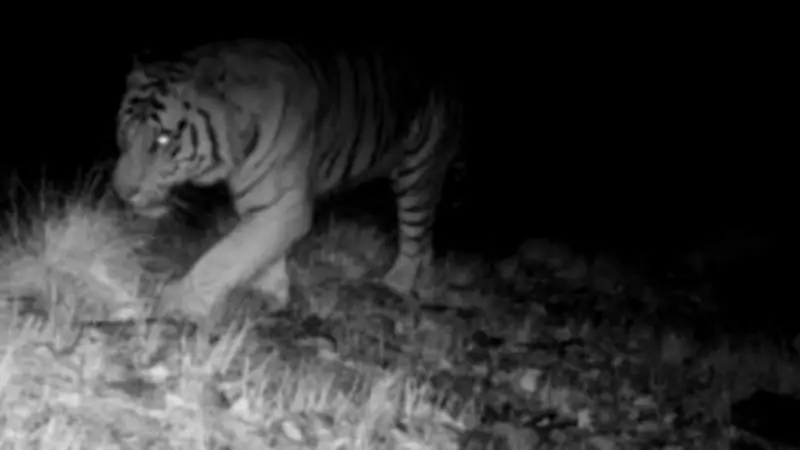
Tiger Spotted Near Hyderabad After 50 Years Sparks Fear in Yadadri District
For the first time in five decades, a tiger has been spotted in close proximity to Hyderabad, sending shockwaves through the rural communities of Yadadri-Bhuvanagiri district in Telangana. The big cat's unexpected appearance, merely 60 kilometers from the bustling state capital, has triggered widespread alarm and forced villagers to alter their daily routines dramatically.
Discovery Through Digital Investigation
The tiger's presence was first uncovered through an unusual combination of traditional observation and modern technology. A young villager named Sreenivas discovered a large, suspicious pug mark in Begumpet, located within Yadadri district. Demonstrating remarkable initiative, he photographed the imprint and conducted a reverse image search on his smartphone. The digital investigation suggested the mark likely belonged to a tiger, prompting him to immediately alert forest department officials.
"He was so confident after his online search that he contacted the forest guards directly," confirmed Sudhakar Reddy, the District Forest Officer. "We visited the site and verified that indeed, a tiger was moving through our territory."

Unpredictable Movements and Growing Concerns
Forest officials have been closely monitoring the tiger's erratic journey, which began approximately 400 kilometers away in Mancherial district. The animal traveled through Kamareddy and Siddipet before reaching Yadadri, covering an additional 100 kilometers within the district itself. This extensive wandering has created significant anxiety among local residents.
"The tiger is moving in a completely unpredictable pattern," explained Reddy. "Sometimes it heads north, making us hopeful it's returning to Kawal Tiger Reserve. Other times it moves eastward, penetrating deeper into populated areas of the district."
Livestock Attacks and Safety Measures
The tiger's presence has been confirmed through a series of livestock attacks that began shortly after its discovery:
- January 17: Initial pug mark discovery in Begumpet
- Following day: Calf found killed in Ibrahimpur village (20km from initial site), left uneaten
- January 25: Calf killed and consumed in Ralla Janagam village
- January 26: Three cows killed in Dattayapalle village
- February 3: Calf mauled to death in Vasanthapuram, Yadadri-Bhuvanagiri district
In response to these incidents, forest authorities have implemented multiple safety measures:
- Issued strict warnings against venturing outdoors after dark
- Distributed drums to villagers for creating noise to deter the tiger
- Deployed camera traps to monitor movements
- Utilized drones with thermal imaging capabilities
- Positioned animal trackers and cages throughout the area
"We no longer step outside after sunset; we mostly remain indoors for safety," shared Ratnamma, a concerned villager, reflecting the community's heightened apprehension.
Feeding Patterns and Conservation Challenges
Camera trap footage revealed the tiger consuming approximately 40 kilograms of meat in one evening—a substantial amount compared to typical consumption patterns. While captive tigers typically receive 8 kilograms daily, wild tigers generally consume around 10 kilograms to survive. "When extremely hungry, a tiger can consume up to 50 kilograms of meat and then go without eating for six to seven days," noted Reddy, highlighting the animal's adaptive feeding behavior.
The forest department's hopes for the tiger's natural return to protected habitat have been repeatedly disappointed. Despite moving toward Siddipet district border—closer to Kawal Tiger Reserve—the animal subsequently changed direction toward Jangaon district, showing no consistent signs of returning to its natural habitat.

Ecological Context and Long-term Implications
This unprecedented tiger movement near Hyderabad raises important questions about wildlife corridors and human-animal conflict management in rapidly developing regions. The sparse vegetation in Yadadri district provides inadequate habitat for sustained tiger presence, making the animal's prolonged stay particularly concerning for both conservationists and residents.
Forest officials continue to hope the tiger will eventually move toward either Amarabad Tiger Reserve in the south or return to Kawal Tiger Reserve in the north. Meanwhile, the department maintains vigilant monitoring while balancing public safety concerns with wildlife conservation priorities in this unusual and tense situation.





