

Young Tiger's Cautious Journey Through Telangana Districts
For the past two weeks, forest officials and wildlife experts in Telangana have been closely monitoring the movement of a young adult male tiger whose footprints have created a living map across the Siddipet and Yadadri Bhuvanagiri districts. The animal's behavior has consistently demonstrated caution rather than aggression, with officials noting its deliberate avoidance of human settlements.
Behavior Patterns and Territory Exploration
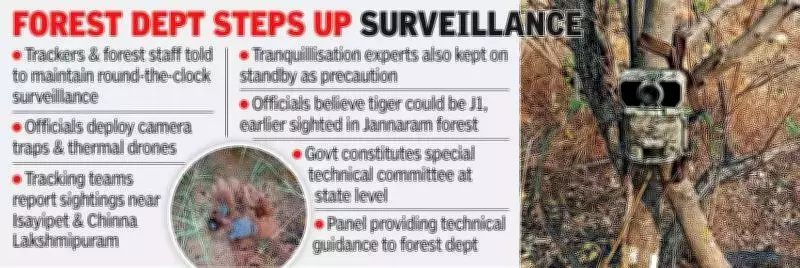
Based on extensive observation of movement patterns and kill history, wildlife experts characterize this tiger as inherently shy. The animal has largely confined itself to forest patches and revenue lands, displaying behavior typical of young tigers still establishing their territory. Forest teams across three districts maintain continuous surveillance, with recent sightings reported near Isaipet and Chinna Lakshmipuram.
Principal Chief Conservator of Forests C Suvarna emphasized the balanced approach being taken: "This is about continuous monitoring without causing inconvenience to people and without causing harm to the tiger." The tiger has maintained a movement range of 6-8 kilometers since entering Telangana, sticking primarily to reserve forest areas and open revenue lands.

Possible Origins and Long-Distance Travel
Officials are investigating potential connections to earlier tiger sightings. Based on stripe patterns, movement characteristics, and kill history, there's speculation this could be tiger J1, previously tracked in the Jannaram forest landscape for nearly two to three weeks. Another possibility under examination is that the animal originated from forest areas in Maharashtra, including the Tipeshwar or Penganga landscapes.
C Suvarna confirmed: "We shared the tiger stripe images with NTCA. They will check the repository and let us know whether it was already captured. It is an active young adult and healthy." If these connections are verified, the tiger would have traveled approximately 300 kilometers—a distance not uncommon for young males dispersing from their natal areas.
Monitoring Strategy and Safety Measures
Forest authorities have implemented a comprehensive monitoring grid across three districts, utilizing camera traps and thermal drones to track movement through fragmented forest landscapes. Cage traps have been strategically placed at key locations, while tranquillisation experts remain on standby as a precautionary measure.
The monitoring follows National Tiger Conservation Authority guidelines, with a high-level review convened under Suvarna's chairmanship to ensure field observations guide the response strategy. Trackers and frontline staff maintain round-the-clock surveillance, regularly reviewing the situation for timely intervention when necessary.
Kill Patterns and Behavioral Assessment
Officials have carefully analyzed the tiger's kill history, noting five calf kills that match patterns typical of young animals still developing hunting skills. This preference for lower-risk prey further supports the assessment of cautious behavior. Importantly, there have been no reports of harm to humans throughout the tiger's movement.
Field observations consistently indicate the animal is engaged in territorial exploration rather than searching for a mate. The tiger's recent movement back from Siddipet toward Yadadri suggests possible retracing of familiar paths, though forest connectivity to larger reserves remains limited.
Future Movement Possibilities
Forest officials have identified several potential dispersal routes for the tiger. C Suvarna outlined the possibilities: "Its dispersal speaks of possible exit routes: back towards the Jannaram landscape and onward to Maharashtra, or a drift towards Amrabad Tiger Reserve or Kawal Tiger Reserve. But the forest patch connecting Yadadri to these areas is not good."
The ongoing monitoring represents a delicate balance between wildlife conservation and public safety, with officials committed to protecting both the tiger and local communities as this remarkable journey continues through Telangana's forest landscapes.






