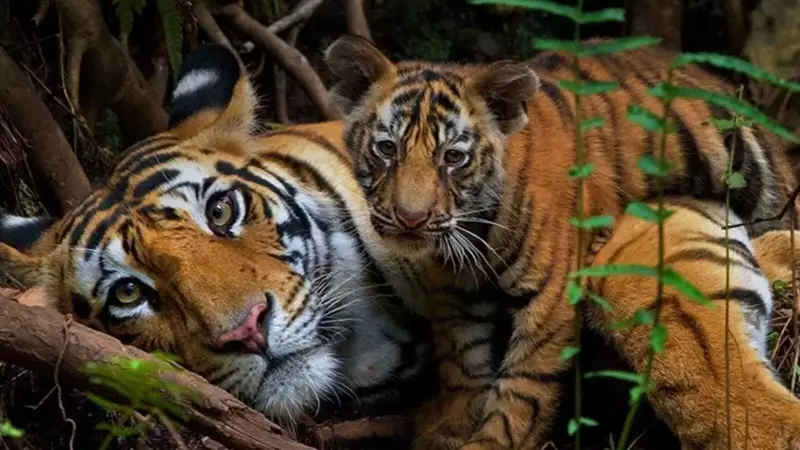
In January 2025, a silent revolution was captured on a grainy camera trap image in the hills of Purulia, West Bengal. For the first time in recorded memory, a wild tiger was seen crossing the scrubland. This was no ordinary sighting; it was the final point on an extraordinary journey that began hundreds of kilometers away, marking a profound shift in India's wildlife landscape.
The Wandering Tiger: A 500-Kilometer Biometric Trail
Forest officials and researchers pieced together the tiger's remarkable path. Its journey was first documented in March 2024 in Balrampur forest division, Chhattisgarh. By summer, it appeared in Jharkhand's Palamau Tiger Reserve. Finally, in early 2025, camera traps confirmed its presence in West Bengal's Purulia and Jhargram districts. The big cat had traversed approximately 500 kilometers through human-dominated terrain, crossing state borders and ecological zones in a relentless search for territory.
This solitary trek is not an isolated incident. It is a direct consequence of India's monumental conservation achievement. The country's wild tiger population has rebounded from a perilous 1,411 in 2006 to around 3,682 in the latest census, representing nearly 75% of the global wild tiger population. This success, the cornerstone of Project Tiger, has created a new and complex challenge: overcrowding in core reserves is forcing tigers to disperse into areas where humans live and work.

The Paradox of Success: When Forests Are Full
Scientists at the Wildlife Institute of India (WII) estimate that a staggering 30% of India's tigers—over 1,100 animals—now live outside designated tiger reserves. This sharpens the urgent challenge of human-tiger coexistence. WII director GS Bhardwaj confirmed that a dedicated Tiger Outside Tiger Reserves (TOTR) project was initiated in 2025, focusing on protecting both tigers and people in these fringe areas.
The pressure is acute in central India. Bandhavgarh Tiger Reserve, with one of the highest tiger densities nationwide, sees intense territorial fights. A state review found these conflicts were a major cause of tiger deaths between 2021 and 2023. With older males holding prime territory, younger tigers are pushed into buffer zones and near villages. Bandhavgarh records over 2,000 cattle kills annually, a stark indicator of the tension at ecological boundaries.
Not all reserves are equally crowded. In Uttarakhand, while Corbett and Rajaji reserves are nearing saturation, nearly half of India's reserves remain below their ecological capacity. Officials note Corbett can support about 20 tigers per 100 sq km, while eastern Rajaji's capacity is around 14 per 100 sq km.
Living with the Ghost of Success: Communities on the Frontline
The tiger's presence now ripples palpably through rural life. In early 2025, schools in several villages of Uttar Pradesh's Pilibhit region were closed due to a prowling tiger, disrupting children's education. In the Gadchiroli district of Maharashtra, tiger numbers exploded from zero to nearly 30 in five years. This led to a tragic outcome: 25 villagers died in tiger attacks across the Wadsa and Gadchiroli divisions in 2024. Despite having 12,000 sq km of forest, the actual usable habitat is constrained, showing that theoretical capacity often clashes with ground reality.
Some encounters are surreal rather than fatal. In a Jharkhand village, a tiger entered a family's hut, settled on a wooden cot, and waited for hours before leaving peacefully. The event left the family in awe and fear, a powerful metaphor for the new proximity.
Conservationists now speak of "social carrying capacity"—not just how many tigers the land can hold, but how many people are willing to tolerate. In response, initiatives like Uttarakhand's Bagh Mitras (village volunteers) have been trained to monitor tiger movement and alert authorities.

The solution is not simple. Translocation efforts, like one attempted in Odisha in 2018, have seen limited success. The focus is shifting to securing and consolidating natural corridors, allowing safe dispersal. Critical corridors in landscapes like the Terai Arc are under threat from development. Meanwhile, some reserves offer hope: Tadoba saw a 30% rise in tiger density over a decade, and the Sundarbans reserve is being expanded by over 1,000 sq km to accommodate its growing population.
The Purulia tiger's journey is a biometric trail and a powerful symbol. India's national animal has triumphantly returned from the brink. Now, the nation faces a more nuanced question: in a country of 1.4 billion people, where can the tiger truly stay?