

Titanic Wreck Evolves into Thriving Artificial Reef After Over a Century
More than a century after its tragic sinking, the RMS Titanic continues to undergo remarkable transformations that extend far beyond structural decay into the realm of biological evolution. A groundbreaking new survey of the iconic wreck and a nearby deep-sea ridge has meticulously documented the diverse animal communities now flourishing across its steel surfaces at an astounding depth of approximately 3,800 metres in the North Atlantic Ocean.
Wreck Site Becomes Habitat for Corals and Sponges
The pioneering research draws extensively on high-definition video footage collected during a comprehensive 2022 expedition, offering a rare comparative analysis between life on the historic wreck and that found on a natural rocky ridge located around 40 kilometres away. Scientists meticulously analysed more than a thousand detailed still images extracted from submersible footage, revealing that the Titanic has effectively transformed into an artificial reef. This man-made structure now supports vibrant colonies of corals, sponges, and mobile invertebrates in an environment that was once dominated exclusively by soft, featureless mud.
Footage from the wreck site clearly shows brittle stars, squat lobsters, sea anemones, and multiple species of sponge firmly attached to railings and broken metal sections. Remarkably, cold-water corals, including species from the genera Chrysogorgia and Lepidisis, have successfully colonised elevated structures such as the iconic bow and various deck fittings. These organisms utilise the steel hull as a crucial hard surface in an otherwise sediment-covered underwater landscape, creating a unique ecosystem that did not exist before the ship's arrival on the seabed in 1912.

Natural Ridge Exhibits Higher Biodiversity
The comparison site, identified as part of a geological feature known as Seamount U, lies at a depth of roughly 2,900 metres and is composed of volcanic rock and pillow lavas. In images captured from this natural ridge, researchers observed a significantly greater number of species and higher overall biodiversity values compared to the Titanic wreck site. Dense clusters of corals, sponges, crinoids, and various fish species were visibly thriving along rocky outcrops, suggesting that the natural ridge offers more stable habitat conditions and potentially stronger currents that efficiently deliver food particles to suspension feeders.
Statistical analyses confirmed that the biological community on the ridge differs markedly from that inhabiting the Titanic. Key factors influencing these differences likely include substrate type, local hydrodynamics, and variations in food supply. Despite recording lower overall diversity at the wreck compared to the nearby ridge, the Titanic supports a distinct and specialised community shaped by its unique artificial structure and ongoing slow decay process.
Documenting Growth and Change Over Decades
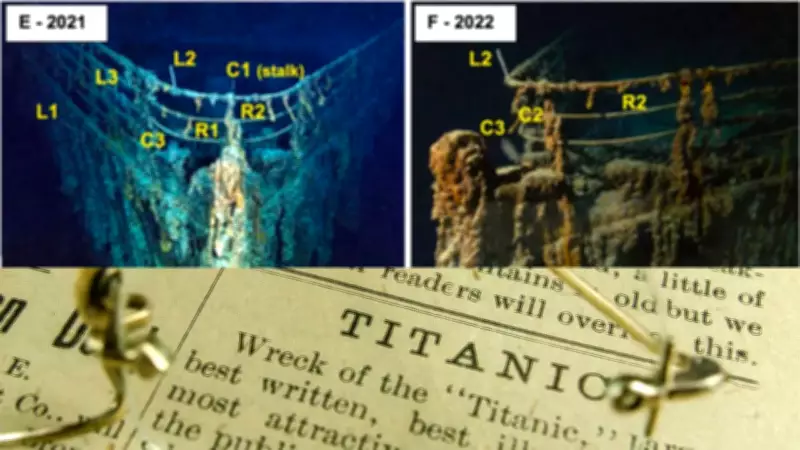
The research team conducted a fascinating temporal analysis by comparing recent high-resolution images with archive footage dating back to 1986. This long-term assessment revealed that certain coral colonies have substantially increased in size over the decades, with estimated growth rates reaching up to 10 millimetres per year for some colonies. Additionally, rust formations known as 'rusticles' have extended significantly, in some cases by approximately 14 millimetres annually.
These documented changes point to an ongoing ecological succession process. As the ship's structural integrity gradually weakens over time, habitats may shift again, creating new opportunities for different species. The wreck is simultaneously deteriorating and supporting life, representing a dynamic deep-sea environment.
Artificial Structures as Ecological Stepping Stones
Shipwrecks at such extreme depths are rarely studied with this level of detail, making these findings particularly significant. The research suggests that artificial structures like the Titanic can act as crucial stepping stones for species dispersal across the vast, otherwise homogeneous deep ocean floor. Marine larvae may initially settle on wrecks before spreading to other hard substrates, facilitating biodiversity in deep-sea regions.

Concurrently, climate change is projected to alter deep-sea temperature profiles, chemical composition, and oxygen levels in the North Atlantic. Such environmental shifts could profoundly influence both coral growth rates and steel corrosion processes in coming decades. For now, the Titanic remains a rare deep-sea site visited frequently enough by researchers to allow meaningful comparisons across multiple decades, its steel frames preserving both human history and a living biological community slowly adapting in perpetual darkness.





