

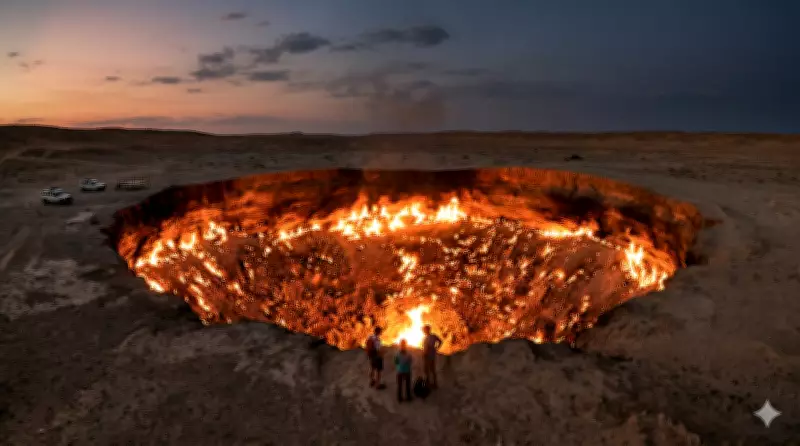
The 'Gate to Hell': A Fiery Phenomenon in Turkmenistan's Desert
In the vast expanse of the Karakum Desert in Turkmenistan, a surreal and captivating sight has persisted for decades: a massive crater ablaze with thousands of flames, famously dubbed the 'Gate to Hell.' This burning pit, however, is far more than a mere spectacle; it represents a profound environmental issue rooted in a scientific mishap from the 1970s. Originally intended as a temporary fix, the fire has raged for over half a century, fueled by seeping natural gas and highlighting critical concerns about methane emissions and global warming.
Origins of the Darvaza Gas Crater
The Darvaza gas crater, commonly referred to as the 'Gate to Hell,' was likely formed in the 1970s when Soviet geologists accidentally drilled into an underground cavern filled with natural gas. The ground collapsed, creating a gigantic crater. To mitigate the release of toxic methane gas, scientists decided to set the crater on fire, anticipating it would burn out within days. Contrary to expectations, the flames have continued unabated for more than 50 years, turning what was meant to be a short-term solution into a long-standing environmental challenge.
Why the Fire Persists: A Constant Fuel Supply
The continuous burning of the crater is sustained by a steady supply of methane gas escaping from underground reservoirs. The Karakum Desert sits atop extensive natural gas deposits, ensuring an ongoing fuel source. Research from institutions like the Research Institute of Water and Environmental Engineering (IIAMA) indicates that methane from such deposits can burn for extended periods, depending on containment efficiency. Essentially, the crater acts as a release valve for a much larger gas supply, meaning the fire is likely to continue as long as methane leaks persist.

The Hidden Threat: Methane Emissions and Climate Impact
While the burning crater is visually striking, scientists are increasingly alarmed by what lies beneath the surface. Methane is a potent greenhouse gas with a significantly higher global warming potential than carbon dioxide over short-term periods. According to the Intergovernmental Panel on Climate Change, methane contributes substantially to global warming. The Darvaza crater leaks methane continuously into the atmosphere; although some is burned off, incomplete combustion means dangerous gases are still released. This poses risks such as:
- Accelerated global warming due to excessive methane leakage
- Further ground instability and potential expansion of the crater
- Long-term environmental damage to the surrounding ecosystem
Scientific Research and Global Implications
The 'Gate to Hell' has attracted worldwide scientific interest, particularly from researchers studying extreme environments and gas emissions. In 2022, studies were conducted to analyze methane flow and burning patterns, aiming to answer crucial questions:
- How much gas is still being released from the crater?
- Is it feasible and safe to extinguish the fire?
- What are the future environmental impacts of this ongoing emission?
These investigations are vital for developing strategies to manage similar gas leaks globally, emphasizing the need for better environmental oversight in resource exploration.
A Symbol of Human Impact on the Environment
The 'Gate to Hell' serves as a stark reminder of the unintended consequences of human activities. What began as a geological accident has evolved into a decades-long environmental problem, underscoring the importance of thorough environmental studies and sustainable energy practices. This fiery landmark is not just a natural wonder but a man-made phenomenon that highlights the delicate balance between resource exploitation and ecological preservation. As scientists continue to monitor the crater, it stands as a testament to the urgent need for addressing methane emissions and mitigating climate change on a global scale.






