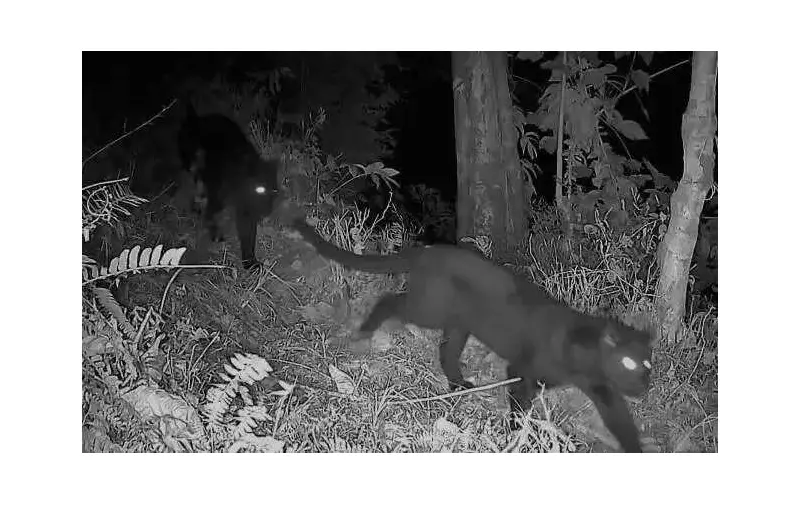
Rare Sighting of Two Melanistic Leopards in Kurseong Forest Division
In an extraordinary event that has captivated wildlife enthusiasts and researchers alike, two melanistic leopards have been photographed together by a camera trap in the Kurseong forest division of North Bengal. This remarkable occurrence is believed to be the first documented instance in the Indian wilderness where two black leopards have been spotted simultaneously. The sighting has sparked significant interest among forest officials and conservationists, highlighting the unique biodiversity of the region.
Camera Traps Unveil Hidden Wildlife
Over twenty trap cameras are currently operational within the Kurseong forest division, deployed as part of a broader initiative to monitor and conserve local fauna. These cameras have not only captured the rare melanistic leopards but have also previously recorded other unusual sightings, including a black barking deer, a black tarantula, and a civet cat with distinctive black stripes. Devesh Pandey, the Divisional Forest Officer (DFO), emphasized that the primary goal of installing these cameras is to generate awareness and foster conservation efforts among the communities that share this landscape with these magnificent animals.
"In one camera, two melanistic leopards have been clicked. It seems they are siblings. We will track them through trap cameras to find out more about them, particularly about their parents," Pandey stated, underscoring the ongoing efforts to study these elusive creatures. The discovery of two black leopards together raises intriguing questions about their genetic lineage and social behavior, prompting further investigation.

Genetic Insights into Melanism
Melanism, the condition responsible for the black coloration in leopards, results from a genetic mutation. According to Uma Ramakrishnan, a renowned Indian molecular ecologist and professor at the National Centre for Biological Sciences in Bangalore, a phenotype—such as the appearance of a black leopard—is determined by observable characteristics influenced by genetics. "Here, the appearance is of a black leopard, which is caused by a genetic mutation. But there has to be two copies of the mutation, one from the mother and one from father," she explained, highlighting the recessive nature of this trait.
Ramakrishnan further elaborated on the factors influencing the frequency of melanism in animal populations. "Generally, if the frequency of the black mutation is low and there is a lot of gene flow—a lot of animal movement due to good forest connectivity—then you are unlikely to keep seeing black leopards. But, if the populations are slightly isolated then it is possible to have an increase in the frequency of black mutation. But, that needs to be studied," she added. This suggests that habitat fragmentation and isolation could play a crucial role in the prevalence of such genetic variations.
Broader Implications for Wildlife Conservation
An Indian wildlife ecologist with experience in the dense tropical forests of North-East India pointed out that studies on habitat fragmentation might provide insights into the rise of melanism. A smaller gene pool resulting from poor connectivity between forests could lead to an increased frequency of this specific genetic mutation. Additionally, the so-called "melanistic barking deer" previously spotted in the region is likely a different species—the Gongshan muntjac, which inhabits areas spanning northwestern Yunnan, southeast Tibet, northeastern India, and northern Myanmar.
Regarding genetic research on black leopards, Ramakrishnan noted that previous studies from Southeast Asia and Sri Lanka have identified mutations in the ASIP gene, which is critical for melanism. "This gene is important for melanism and there are different mutations in the gene that can make it not work properly and as a result, you get this phenotype. To investigate this we need many black leopard samples. We have got some and may be, by end of this year, we will come out with a report," she revealed, indicating ongoing scientific efforts to unravel the mysteries of these rare animals.

Key Takeaways from the Discovery
- A black leopard is a melanistic variant of the common leopard, appearing black due to a genetic mutation called melanism.
- If the frequency of the black mutation is low and there is substantial gene flow, sightings of black leopards remain rare.
- Isolated populations may experience an increase in the frequency of the black mutation, necessitating further study.
- Other melanistic animals, such as black deer, black tarantulas, and black-striped civets, have also been observed in the Kurseong forest division, underscoring its ecological significance.
This unprecedented sighting not only enriches our understanding of wildlife genetics but also underscores the importance of conservation initiatives in preserving India's natural heritage. As forest officials continue to monitor these melanistic leopards, the findings promise to contribute valuable knowledge to the fields of ecology and genetics.