

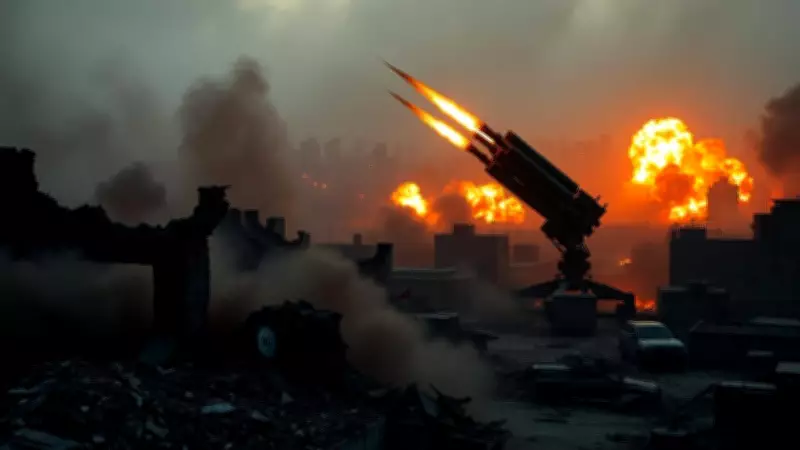
US Army Achieves Historic Artillery Strike with Precision Strike Missile in Iran
The United States Central Command has announced a landmark military achievement, recording the longest artillery strike in Army combat history during the ongoing conflict in Iran. This precision attack was executed using the long-range Precision Strike Missile (PrSM), colloquially known as prism, launched from advanced systems like the M142 High Mobility Artillery Rocket System (HIMARS) or the M270 Multiple Launch Rocket System (MLRS). These platforms are the backbone of tactical rocket launch systems in the US Army, enabling unprecedented reach and accuracy on the battlefield.
Unmatched Lethality and Strategic Impact
Admiral Bradley Cooper, leader of America's Central Command, emphasized the significance of this strike, stating, "The US Army launched the longest field artillery strike in Army combat history using the Precision Strike Missile. The strike took out Iranian military infrastructure, demonstrating the US military's unmatched reach and lethality." The PrSM boasts a maximum range of 500 kilometers and carries a 91 kg warhead, which, while slightly less powerful than India's indigenous Pinaka rocket system, showcases cutting-edge technology. Lockheed Martin, the manufacturer, is actively working to double this range to 1,000 kilometers through enhanced aerodynamics and propulsion improvements.
Global Rocket Artillery Developments and Historical Context
India is also advancing its rocket artillery capabilities, with plans to extend the Pinaka system's range from its initial 37.5 kilometers to 120 kilometers and potentially 300 kilometers, enabling strikes deep into Pakistan and the Tibetan plateau. The Indian Army currently operates seven Pinaka regiments, with plans to expand to 22, alongside Russian-acquired systems like the 122mm Grad MLRS and 300mm Smerch MLRS. Historically, rockets have played a pivotal role in warfare, from Tipu Sultan's use against the British in the Anglo-Mysore Wars, which were later reverse-engineered by the British, to their deployment in World War II with systems like the Russian Katyusha and German innovations.

Rocket Artillery as a Multi-Role Platform in Modern Warfare
Rocket artillery bridges the gap between conventional gun artillery and heavier weapons such as cruise or ballistic missiles, offering the ability to saturate large areas or strike with scalpel-like precision. The PrSM systems used in the Iran conflict exemplify this, allowing destruction of deep enemy targets without risking aircraft and crews. Army chief General Upendra Dwivedi has highlighted the need for a rocket-cum-missile force, a requirement underscored by the kinetic phase of Operation Sindoor and the operational rocket forces of Pakistan and China. Recent uses from Ukraine to Israel and now Iran demonstrate that MLRS systems are becoming indispensable in modern combat, shaping up as multi-role platforms in the age of precision firepower.






