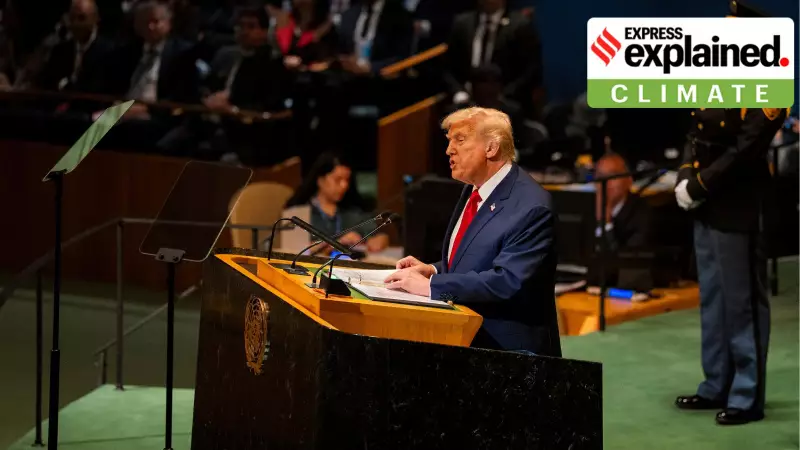
The United States has declared a historic and sweeping withdrawal from the cornerstone of global climate cooperation, a move that sends shockwaves through international environmental diplomacy and presents a dual-edged sword for India. On Thursday, January 8, 2026, the US announced its exit from the UN Framework Convention on Climate Change (UNFCCC) and over 60 other international treaties and organizations it deems contrary to American interests.
A Complete Disengagement from Global Climate Architecture
This drastic step marks the culmination of a year-long retreat from climate commitments under President Donald Trump's second term. The process began last year with the US initiating withdrawal from the 2015 Paris Agreement, a decision set to become official on January 20, 2026. The administration had already scaled down funding and staffing for domestic climate research agencies.
The latest list of exits includes pivotal climate entities: the Intergovernmental Panel on Climate Change (IPCC), the International Renewable Energy Agency (IRENA), and notably, the International Solar Alliance (ISA). The ISA was launched by India and France during the COP21 summit in Paris, with the US joining as the 101st member only in 2021.

Short-Term Relief vs. Long-Term Strategic Challenges for India
For India, the immediate fallout is mixed. On one hand, the absence of the world's historically largest emitter from climate negotiations could mean reduced diplomatic pressure on India to accelerate its decarbonisation timeline. The US was a significant voice in pushing for ambitious global targets.
However, the strategic drawbacks are substantial. Before Trump's return, India and the US shared a robust partnership on climate and clean energy. The US supported numerous initiatives across energy sectors in India. This collaboration is now expected to grind to a halt, potentially forcing India to recalibrate its energy transition pathways and seek alternative partners for technology and investment.
The US exit from the ISA, while symbolic—as it provided no financial support—is a diplomatic setback for an alliance championed by New Delhi. The ISA had recently decided to levy an annual membership fee of $50,000 for developed nations and $25,000 for developing countries, a structure not yet operational.
Global Vacuum and China's Rising Dominance
By completely disassociating from the international climate regime, the US risks ceding global leadership and economic advantage in the clean energy race to its chief rival, China. Renewable energy sources like solar and wind are now economically competitive and offer energy security, driving a global transition.
China holds a dominant position in manufacturing renewable energy equipment and controlling supply chains. As the US vacates this space, it undermines its own future economic interests and political influence. While the Trump administration's efforts to boost fossil fuel supply might slow the global energy transition, they are unlikely to reverse the overarching trend toward renewables.
In the short term, the direct impact on global emissions might be marginal, as the world was already off track for its 2030 targets. The long-term consequences, however, hinge on the policies of future US administrations. The current withdrawal jeopardizes decades of scientific cooperation and multilateral consensus-building, with the US potentially isolating itself on one of the defining issues of the century.