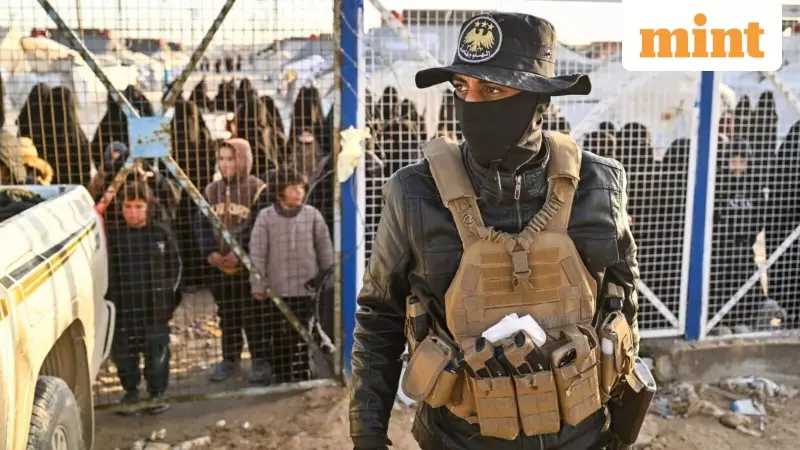
In a significant development highlighting ongoing security challenges in the Middle East, the United States has initiated an urgent transfer of captured Islamic State fighters from detention facilities in northeast Syria to undisclosed locations in Iraq. This move comes amid heightened fears that escalating tensions between pro-government Syrian forces and a Kurdish-led militia could lead to a security breakdown, potentially allowing thousands of militants to escape.
Mass Prisoner Transfer Underway
According to U.S. officials, a group of 150 ISIS fighters held at a prison in Hasakah, Syria, were transported via a U.S. C-17 military aircraft to Iraq on Wednesday. Officials have indicated that up to 7,000 additional ISIS detainees could follow in the coming days, marking one of the largest prisoner transfers in recent years. The operation reflects deep concerns about the stability of detention centers in Syria following recent political changes.
Background of Regional Instability
The transfer occurs against a backdrop of significant political shifts in Syria. In December 2024, former President Bashar al-Assad was overthrown, leading to the establishment of a new government under former rebel leader Ahmed al-Sharaa. This new administration has signed a ceasefire agreement with the Kurdish-led Syrian Democratic Forces (SDF), calling for the integration of individual SDF members into Syrian security forces. However, confidence in this truce remains low among international observers.

Charles Lister, a senior fellow at the Middle East Institute, commented on the situation, stating, "This is because there is little confidence that this cease-fire is going to last. It is also reflective frankly of the fact that the U.S. does not have the troop capacity to take charge even temporarily of the facilities themselves."
Security Concerns and Recent Incidents
The urgency of the prisoner transfer is underscored by recent security incidents. In recent days, several low-level ISIS prisoners escaped from a detention facility in Shaddadi, eastern Syria, during fighting around the compound. Although many were recaptured by Syrian government forces, the incident highlighted vulnerabilities in the detention system. The persistent threat from ISIS remnants was further demonstrated in December when a gunman ambushed U.S. forces near Palmyra, resulting in casualties including members of the Iowa National Guard.
Admiral Brad Cooper, leader of U.S. Central Command, emphasized the importance of secure transfers, stating, "Facilitating the orderly and secure transfer of ISIS detainees is critical to preventing a breakout that would pose a direct threat to the United States and regional security."
Strategic Shift in U.S. Policy
The prisoner transfer signals a notable shift in U.S. counterterrorism strategy in the region. For over a decade, the U.S. maintained a security partnership with the SDF, a coalition of Kurdish and Arab fighters that operated autonomously in northeastern Syria. With the new Syrian government under Sharaa joining the U.S.-led coalition against ISIS in November, Washington is now aligning more closely with Damascus.
Tom Barrack, former special envoy for Syria under President Trump, noted on social media, "The original purpose of the SDF as the primary anti-ISIS force on the ground has largely expired, as Damascus is now both willing and positioned to take over security responsibilities, including control of ISIS detention facilities and camps."
Historical Context and Ongoing Challenges
ISIS first gained global attention in 2014 when it captured large parts of northeast Syria and Iraq, including Mosul. A U.S.-led coalition, with Iraq providing ground troops and the U.S. offering air support and advisors, eventually collapsed the group's self-declared caliphate in 2019. However, the defeat left thousands of hardened ISIS fighters in detention, many from foreign countries reluctant to repatriate them, along with tens of thousands of refugees at camps like Al-Hol.

The transfer of detainees to Iraq represents a pragmatic solution to a long-standing problem. While handing over camps to Assad's government was previously untenable for the U.S., Sharaa's rise has enabled a shift in control to Syrian authorities, albeit with continued U.S. oversight in the transfer process.
As tensions continue to flare in Syria, the rapid movement of ISIS prisoners underscores the fragile security environment and the ongoing global effort to prevent a resurgence of militant threats in the region.