

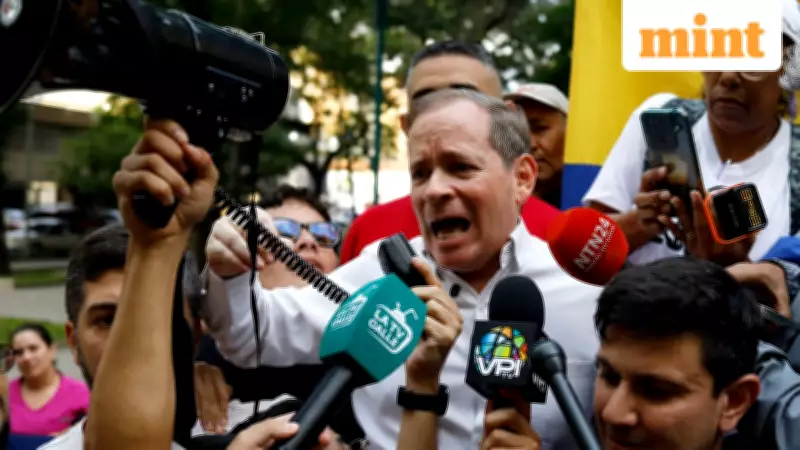
Venezuelan Opposition Leader Abducted Hours After Prison Release
In a shocking development that has sent shockwaves through Venezuela's political landscape, prominent opposition figure Juan Pablo Guanipa was reportedly kidnapped by armed men in Caracas mere hours after his release from prison. The incident occurred late Sunday night, casting a dark shadow over what opposition allies had described as a renewed push by authorities to meet international demands for political prisoner releases.
The Alleged Kidnapping Incident
According to opposition leaders and family members, Guanipa was seized by unidentified assailants in the Los Chorros neighborhood of the capital. Venezuelan opposition leader María Corina Machado provided chilling details on social media platform X, stating that "heavily armed men dressed in civilian clothes arrived in four vehicles and took him away by force."
In a separate social media video that has circulated widely, Guanipa's son Ramón offered a harrowing account of the incident. He claimed his father was attending an event at approximately 11:45 PM when he was "ambushed by approximately 10 agents who had no identification whatsoever." Ramón described how the armed men pointed their weapons at those present before forcibly taking his father away, concluding with an emotional plea for proof that his father remains alive.

Who Is Juan Pablo Guanipa?
Juan Pablo Guanipa represents a significant figure in Venezuela's decades-long political confrontation between government and opposition forces. As a lawyer and long-standing opposition politician, he has served in multiple high-profile roles:
- First Vice President of the National Assembly of Venezuela
- Deputy representing Zulia state
- Key figure in Primero Justicia (Justice First), one of the main opposition parties
Guanipa's national prominence increased substantially in 2017 when he was elected governor of Zulia state, though this result was later annulled after he refused to take an oath demanded by the government-aligned Constituent Assembly. He also briefly pursued a presidential bid before his party opted to boycott the 2018 election amid allegations of electoral unfairness.
From Prison Release to Alleged Abduction
Guanipa had been detained since May 2025 following accusations by Interior Minister Diosdado Cabello that he was involved in an alleged "terror" plot connected to regional and legislative elections. These claims were made without evidence, and Guanipa consistently denied any wrongdoing throughout his more than eight months of detention.
His release on Sunday night initially appeared to signal a positive development. Shortly after leaving a detention center in Caracas, Guanipa posted an optimistic message online stating: "Today we are being released. Much to discuss about the present and future of Venezuela, always with the truth at the forefront."
This brief moment of freedom was tragically short-lived, with the reported kidnapping occurring just hours later.
Political Reactions and Accusations
Following the alleged abduction, Guanipa's Primero Justicia party issued a strongly worded statement on X, directly accusing the Caracas regime of responsibility for the kidnapping. The party declared: "We hold (interim President) Delcy Rodríguez, (National Assembly President) Jorge Rodríguez, and (Interior Minister) Diosdado Cabello responsible for any harm against the life of Juan Pablo."
The Venezuelan government has not publicly responded to these serious allegations made by opposition leaders and Guanipa's family members.
Broader Context of Political Prisoner Releases
Guanipa's release formed part of a wider set of prisoner releases that opposition leaders and human rights groups say has accelerated in recent days. According to human rights organization Foro Penal, at least 30 political prisoners were confirmed released on Sunday alone, including:

- Lawyer Perkins Rocha (released under strict restrictions according to his wife)
- Luis Somaza of the Popular Will party
- Activist Jesús Armas
These releases come days after National Assembly President Jorge Rodríguez promised relatives of political prisoners that "all detainees" would be freed "no later than" Friday, February 13. His remarks coincided with the advancement of an amnesty bill that officials claim could lead to a mass release of prisoners, including some held since Hugo Chávez came to power in 1999.
Disputed Narratives and Ongoing Tensions
Despite government announcements of releasing "a significant number of people," rights groups and families argue that the pace has been slow and uneven. Foro Penal reports that more than 380 people have been freed so far, while government claims exceed 800 releases.
Against this backdrop of disputed narratives, Guanipa's alleged abduction has emerged as a new flashpoint in Venezuela's ongoing political crisis. Opposition figures warn that this incident may signal continued repression even as the state presents prisoner releases as evidence of reform. The situation highlights the deep tensions that persist in Venezuela's political landscape, where accusations of arbitrary arrests and human rights violations remain central to the conflict between government and opposition forces.





