

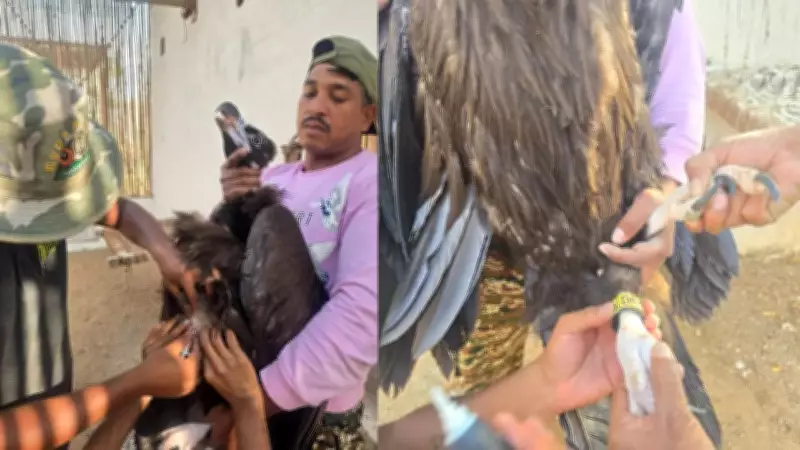
Cinereous Vulture's Remarkable Cross-Border Journey and Double Rescue
A remarkable story of international wildlife conservation has unfolded as a Cinereous vulture, rehabilitated in Madhya Pradesh, was injured again in Pakistan just days after its release, only to be rescued through coordinated efforts between the two nations.
Initial Rescue and Rehabilitation in Madhya Pradesh
The approximately two-year-old female vulture, identified as MPFD/VVNP/BNHS/002, was first rescued on January 22, 2026, from Parsulia village in the Susner range of Shajapur district. Found in an injured condition, the bird was transported to Van Vihar National Park in Bhopal for immediate veterinary intervention at the quarantine facility.
On February 9, the vulture was transferred to the Vulture Conservation Breeding Centre at Van Vihar, managed jointly with the Bombay Natural History Society. Here, it underwent intensive, protocol-based rehabilitation that included scientific documentation and continuous monitoring.

The bird was fitted with both a metal identification ring and a microchip, while undergoing comprehensive clinical, behavioral, and morphometric assessments. Blood samples were analyzed through detailed haematological and biochemical investigations. Initially suffering from a leg injury, the vulture gradually recovered under continuous veterinary supervision and was eventually declared "fit for release" based on established scientific parameters.
Release and Cross-Border Migration
As part of post-release monitoring protocols, the vulture was fitted with a GPS–GSM telemetry device on March 25 through collaboration between WWF-India and BNHS. After a period of observation following tagging, it was released into the wild at Halali Dam in Raisen district on March 30, a site specifically selected for its habitat suitability and prey availability.
Tracking data revealed the vulture's steady northwest movement after release, traversing through Madhya Pradesh and Rajasthan before crossing the international border into Pakistan by April 6. The last recorded location placed the bird in the Khanewal area of Pakistan before the signal ceased transmission.
Second Rescue in Pakistan and International Coordination
The coordinates were immediately shared with WWF-Pakistan for ground verification. Their teams reached a village in Khanewal district and located the injured vulture on the ground. Pakistani officials informed their Indian counterparts that a severe hailstorm had struck the Khanewal and Multan regions on April 7, likely forcing the bird to land unexpectedly.
Through coordinated efforts between officials in both countries, the vulture was traced to local farmers who had spotted the grounded bird and alerted the District Wildlife Office. Pakistan's forest department, along with local police and conservation teams, rescued the bird and provided initial treatment before transferring it to the Changa Manga Vulture Captive Breeding Centre.
Officials at the centre reported that the vulture sustained only minor injuries and remains stable while feeding normally. However, the GPS–GSM telemetry device fitted on the bird could not be located during the rescue operation.
Ongoing Conservation Efforts and Historical Context
WWF-India has maintained continuous coordination with WWF-Pakistan regarding the bird's health and recovery progress. Based on tracking data, timing, and recovery details, officials have confirmed that the rescued bird is indeed the same individual released from Madhya Pradesh.
State's Chief Wildlife Warden Samira Rajora emphasized that the vulture will remain under care in Pakistan and will be released back into the wild once fully recovered. She noted that this effort builds upon earlier successes by the Vulture Conservation Breeding Centre at Van Vihar.
In 2025, a rescued Eurasian Griffon Vulture was treated, tagged, and released at Halali Dam on March 29. Tracking later revealed an extraordinary journey of over 4,300 kilometers, with the bird reaching its breeding grounds in Kazakhstan after passing through Pakistan, Afghanistan, and Tajikistan, before returning to India in October.

"The study provided key insights into migratory routes, habitat use, and survival patterns, while highlighting the significant challenges in cross-border conservation," explained another conservation officer.
Establishing Van Vihar as a National Conservation Hub
On February 23, 2026, five additional vultures—including four Long-billed Vultures and one Cinereous Vulture—were rehabilitated, tagged, and released from Van Vihar. These initiatives collectively establish Van Vihar National Park as a national centre for vulture conservation, integrating comprehensive veterinary care, field science, and advanced tracking technology.
Officials emphasize that such efforts not only advance scientific understanding of migratory species but also strengthen international cooperation for wildlife conservation across political boundaries. The case particularly highlights the critical role of scientific rehabilitation, tagging protocols, real-time monitoring systems, and cross-border coordination in protecting vulnerable migratory species like the Cinereous vulture.





