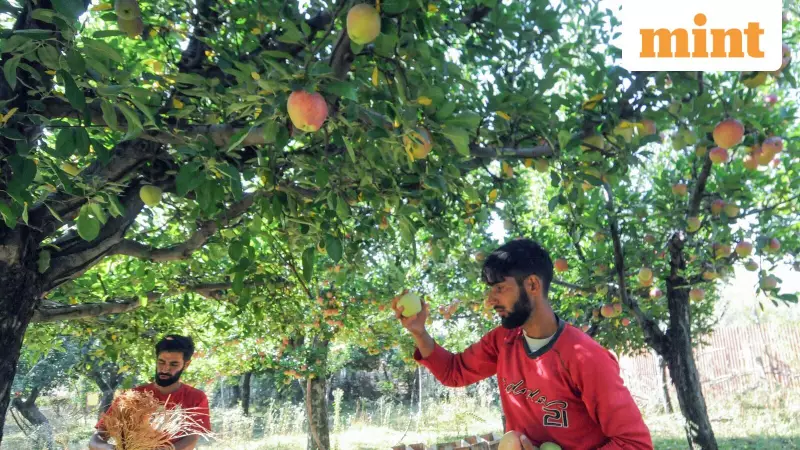
For Kashmir's apple growers, the changing climate is not a distant threat but a present-day financial catastrophe. With horticulture forming the backbone of the Union Territory's economy, generating an estimated ₹15,000 crore annually and supporting over 3.5 million livelihoods, the absence of a reliable crop insurance safety net is pushing farmers into a relentless cycle of debt and despair.
The Silent Suffering in the Orchards
In the village of Allaiepora in Pulwama, Khursheed Ahmad Allaie surveys his 15-kanal orchard, pointing to scars left by last August's extreme weather. The 34-year-old farmer explains how global warming has fundamentally altered his profession. "Heatwaves bring disease. Hailstorms destroy crop quality. Apples that should be A-grade become C-grade, bringing only losses," he says. His story mirrors that of thousands. Once optimistic about high-density plantations, many growers now watch their investment decay, with piles of rotten fruit symbolizing their silent losses.
Further south in Katrasoo, Kulgam, Mohammad Yousuf Bhat walks through his family's 12-kanal orchard, tended for nearly 80 years. Each season is a gamble against hailstorms, heatwaves, and snowless winters. A recent hailstorm wiped out half his crop. In 2020 and 2021, early snowfall snapped ancient, fruit-laden trees. The insurance relief he received was a paltry ₹1,000, an amount he says "barely covered anything" against soaring input costs for pesticides, labour, and irrigation.

Systemic Hurdles: Data Gaps and Flawed Design
Despite the glaring need, crop insurance in Kashmir remains exclusionary. While the Pradhan Mantri Fasal Bima Yojana (PMFBY) now covers all 20 districts of J&K, its benefits have largely bypassed horticulture. Since its 2016 launch, about 960,000 farmers have been insured, with claims worth ₹156 crore settled. However, most payouts have gone to wheat, paddy, and oilseeds from the Jammu region.
In the Kashmir Valley, only about 16% of cropped land is insured, far below the government's 25% target. Bashir Ahmad Basheer, chairman of the Kashmir Valley Fruit Growers-cum-Dealers Union, states bluntly, "The scheme does not effectively cover horticulture. Our economy depends on fruit, not food grains."
Experts pinpoint the core issue: a crippling lack of data. Former mission director of crop insurance, Altaf Aijaz Andrabi, says insurers are hesitant because there is no standardized, notified yield assessment model backed by long-term weather data for apples. Climate change has turned apples into a "highly fluctuating, high-risk crop," eroding the predictability insurers require.
Economist and former finance minister Haseeb Drabu emphasizes this point, noting, "You cannot design insurance without data. You need at least a hundred years of weather and yield patterns to assess risk." He adds that traditional orchards with variable yields are harder to insure than uniform, high-density plantations.
Administrative Bottlenecks and Financial Barriers
Operational glitches have further stalled progress. Suhail Inamullah, technical officer to the director of agriculture, Kashmir, explains that earlier tender rules required companies to bid for entire crop clusters. If even one crop, like apples, was left out due to the lack of a yield-assessment module, the entire bid failed.
Affordability is another major wall. Under the current structure, premiums are capped at 25%, shared between the Centre, UT government, and farmers. Andrabi argues that even the farmer's 5% share is often too high, suggesting premiums must fall to around ₹8,000 per hectare to be viable for growers already struggling to recover input costs.
Javid Ahmad Dar, J&K's minister for agriculture production, acknowledges the lack of insurer interest. "There are very few bidders," he says, attributing it to companies' profit motives and caution over repeated weather events.
A glimmer of hope emerged in 2025 when the government invited fresh bids for horticulture insurance, attracting four companies for Kashmir and five for Jammu—an unprecedented level of interest. Authorities are also implementing the Restructured Weather-Based Crop Insurance Scheme (RWBCIS) for horticulture, designed to cover losses from hailstorms, uneven temperatures, and excessive rainfall.

Yet, for farmers like Khursheed Allaie, who faces pending bills for fertilizer and his children's school fees, promises feel distant. "If there had been insurance, we could have waited. Even if the crop spoiled, compensation would have helped us survive," he says, capturing the desperate need for a system that matches the scale of the crisis unfolding in Kashmir's iconic orchards.