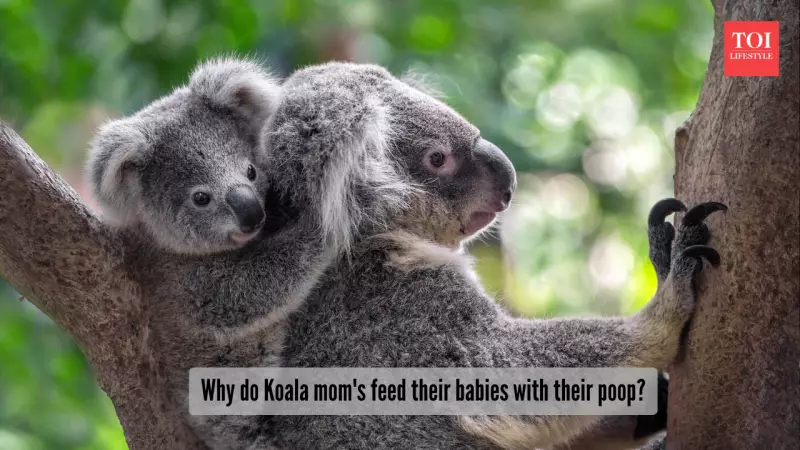
In the wild, the rules of survival are simple. What works, works. For animal mothers, raising their young is a serious business where cuteness takes a backseat to necessity. Birds swallow fish whole to later regurgitate meals for their chicks. Pandas dedicate their lives to chewing tough bamboo. But one Australian marsupial takes parental care to an astonishing, and initially shocking, level.
The 'Pap' Phenomenon: A Koala's Starter Kit
Koala mothers perform a unique ritual. They feed their tiny babies, known as joeys, a special kind of their own feces. This substance is called pap. It is not the typical dry, pellet-like koala droppings. Instead, pap is soft, mushy, and loaded with millions of vital microbes.
This strange practice is not a sign of poor hygiene but a critical biological handover. A newborn joey faces a massive problem: its mother's diet. Adult koalas survive almost exclusively on eucalyptus leaves, which are highly toxic to most animals. A joey's undeveloped digestive system cannot process these poisonous leaves on its own.

Why This Disgusting Act is a Lifesaver
Joeys are born incredibly small, about the size of a jellybean. They spend their first months safely tucked in their mother's pouch, surviving on milk. However, around five to six months of age, they must prepare for the adult diet. This is where pap becomes non-negotiable.
The pap acts as a biological starter kit. It directly transfers the precise gut bacteria required to break down the tough eucalyptus fibre and neutralise its natural toxins. Essentially, the mother's poop teaches the baby's stomach how to eat its only future food source. The joey actively participates by nudging its mother to trigger the release of this life-saving substance.
Scientists clarify that pap originates from a different part of the digestive tract than regular waste, making it uniquely valuable. Without this microbial inoculation, joeys can become seriously ill and may not survive the transition to solid food.
Koalas Are Not Alone: The Coprophagy Club
While the koala's method is particularly direct, it is not the only species that uses feces for survival. This practice, known as coprophagy, is observed in several animals.
- Rabbits, guinea pigs, and capybaras consume soft feces to reabsorb nutrients missed during the first digestion.
- Naked mole rats engage in similar behavior for colony health.
- Even young ostriches, iguanas, and elephants have been seen eating dung for nutritional benefits.
- Beyond consumption, dung beetles entire ecosystems rely on feces, playing a key role in waste recycling and pest control.
For these creatures, skipping this step is not merely unhealthy; it can be fatal. It is a powerful evolutionary shortcut.
The koala mother's seemingly gross habit is, in reality, a masterpiece of natural engineering. It is a vital rite of passage that ensures the next generation can thrive on a toxic diet. This process reminds us that in the animal kingdom, survival strategies are not designed for human approval. They are designed to work. And turning mother's poop into a baby's superpower is, undeniably, a stroke of evolutionary genius.