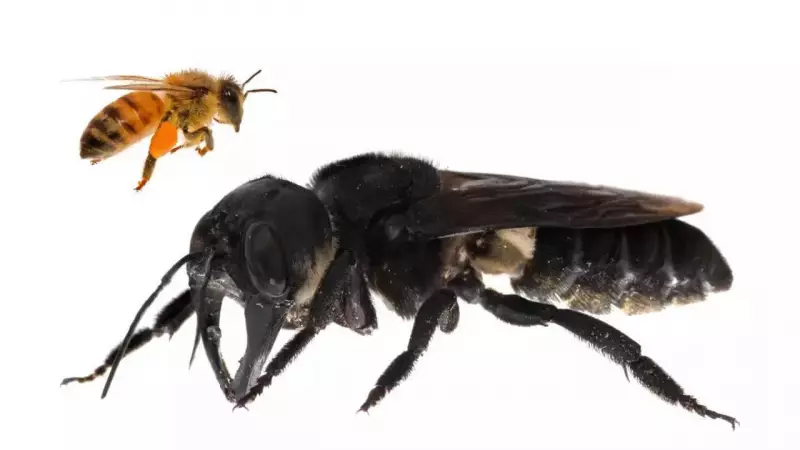
In a remarkable discovery that thrilled the scientific community, the world's largest bee, a solitary insect thought to be lost for decades, was confirmed alive in the remote islands of eastern Indonesia. Known as Wallace's giant bee, or Megachile pluto, this colossal insect had existed primarily as a museum specimen for much of the twentieth century. Its dramatic rediscovery in the late 2010s has cast a spotlight on a creature defined by its extreme rarity, specific habitat needs, and the fragile ecological web it supports.
The Anatomy of a Giant: What Makes This Bee Unique
Wallace's giant bee belongs to the Megachilidae family, which includes leafcutter bees. What sets it apart is its staggering size. Adult females can grow to nearly four centimetres in body length, with wings spanning over six centimetres. This makes it unmistakably larger than any other known bee species. Its body is mostly black with a glossy appearance, lacking the fuzzy coat common in many bees. The most extraordinary feature is the female's massive, elongated mandibles. These powerful jaws are not for fighting but are specialised tools for gathering and manipulating tree resin, a key material for its nest.
A Precarious Home in the North Moluccas
The entire known population of this giant bee is confined to a small cluster of islands called the North Moluccas, including Bacan Island. It inhabits lowland tropical forests, often in patches remaining near agricultural land. Reports from its rediscovery, notably by National Geographic, indicate searches occurred in landscapes altered by logging and farming, suggesting some tolerance to habitat change. However, the bee's survival hinges on very specific conditions: the presence of large trees, suitable microclimates, and active termite mounds. Being restricted to a small island group makes it extremely vulnerable. Unlike widespread species, it cannot easily relocate if its habitat is disturbed, explaining its elusive nature and low population density.

A Master Builder: Nesting Inside Termite Mounds
The nesting behaviour of Wallace's giant bee is as unique as its size. Females construct their nests inside active arboreal termite mounds high up in trees. Using their formidable mandibles, they scrape resin from trees, mix it with wood fragments, and use it to line a cavity they excavate within the termite structure. This ingenious strategy provides a protected environment with stable humidity and temperature. This relationship, confirmed by recent observations, ties the bee's fate directly to two other forest components: resin-producing trees and specific termite species. The loss of either could spell disaster for the bee's ability to nest.
The Great Rediscovery and What It Means
For years, with no confirmed sightings, experts feared the bee was extinct. This changed in 2019 when an expedition, collaborating with local guides, successfully located, photographed, and documented a living female before releasing it back into the wild. This proved the species persists, albeit in small, scattered populations. The event highlighted how difficult it is to document rare, solitary species in challenging terrain, even one as large as this. It underscored the value of targeted, historically-informed fieldwork over broad surveys.
The significance of Wallace's giant bee extends beyond its impressive stature. As a pollinator, it likely visits robust forest flowers, aiding plant reproduction. Its nesting activity physically alters termite mounds. Its continued existence is an indicator of a healthy, interconnected ecosystem with mature trees, thriving termites, and floral resources. Losing this specialised giant would mean the irreversible loss of a unique ecological interaction that more common pollinators cannot replicate. Its story is now a crucial part of global conversations on insect decline, tropical forest conservation, and the race to document biodiversity before it vanishes.