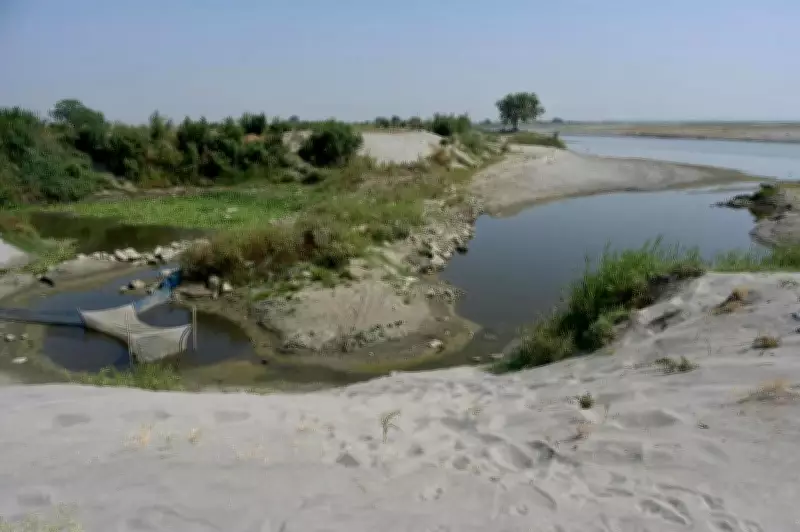
The Yamuna River has narrowed into a thin brownish stream at the point where it flows from Haryana into Delhi. The trickle, flanked by exposed sandbanks and stretches of dry riverbed, has made it easy for people to cross the river from villages in Delhi and Haryana to those in Uttar Pradesh on foot. For villagers living along its banks in this stretch, parts of the river turning into pools of shallow, stagnant water is an annual sight.
Current Condition of the Yamuna
On Wednesday, a visit to north Delhi's Palla village, where the Yamuna enters the city, revealed children knee-deep in water using a narrow channel to walk from villages of one state to another. Bullock carts carrying agricultural produce were trundling along this riverine route from Palla and Haryana's Dahisara village to Uttar Pradesh's Sankroud. The Yamuna shrinks considerably between late winter and early summer, resulting in a perennial river turning into a virtually seasonal one in its upper and middle segments, including Delhi.
Rajpal Singh, a 71-year-old retired beldar from Delhi's irrigation and flood control department, said, "Every year, it is reduced to a thin channel around this time of the year. Haryana's drain number eight releases water into the river only during monsoon. With limited amount of water released into it from Haryana in summer, Yamuna no longer resembles a river."

Water Release and Ecological Needs
According to an official mandate, Haryana's Hathnikund Barrage releases just 9.9 cumecs (352 cusecs) into the Yamuna. Bhim Singh Rawat, a Yamuna activist and associate coordinator of the South Asia Network on Dams Rivers and People, explained, "This is too little and cannot meet the ecological needs of the river. Also, this water can travel barely 10 kilometers downstream in summer through the vast stretches of the floodplains, factoring in percolation and evaporation." A study by the National Institute of Hydrology in 2019 recommended a flow of 23 cumecs in the lean season, he added.
The total length of the Yamuna flowing through Delhi is around 52 km, of which 22 km is extremely polluted. Rawat noted, "Natural depressions and pits have formed upstream of bridges, creating a false impression of the water level being satisfactory. Yamuna no longer resembles a river in the summer season as it is deprived of sufficient water level round the year, barring monsoon." All basin states have spent crores on cleaning it without tangible results, but have ignored ensuring its ecological flow, particularly during the lean season.
Expert Opinions
Manu Bhatnagar, principal director of the Indian National Trust for Art and Cultural Heritage (INTACH), said the river's condition is dire this year. "During the lean season, it receives water from melting snow in the Himalayas and from groundwater seepage. However, snowfall was on the lower side this winter. Also, the ongoing heatwave is causing evaporation losses, making the situation worse than usual."
Singh recalled that around 30 years ago, he used to frequently check the water level at Palla and found plenty of fish. "However, I haven't seen a single fish in this stretch for years now. Even two decades ago, Yamuna's water was largely clean. But it is so dirty now that I can't see anything. The river has been dying slowly," said Singh, a resident of Bakhtawarpur village.
Water Quality Data
A recent check of the river's water quality revealed that out of eight locations from which samples were collected on April 7, it was found to be least polluted at Palla. However, Delhi's last monitoring station at Asgarpur (after the confluence of Shahdara and Tughlakabad drains) was most polluted. Dissolved oxygen, which should be 5 mg/l or above in the river, met the standard only at Palla (5.2 mg/l), but was nil at six other sites. Dissolved oxygen indicates the chances of aquatic life surviving in a river.
Fecal coliform, an indicator of untreated sewage in the river, was recorded at 2,800 MPN/100 ML at Palla but rose to 3,10,000 at Asgarpur. The safe limit is 2,500, and the desired level is below 500.

Impact on Local Communities
The shrinking and dirty river has impacted the lives of those dependent on it. Vinod Kumar, a farmer, said, "We grew up drinking Yamuna's water but it is impossible to do so now. In summer, we used to take a bath in the river for hours to beat the heat. But we have discontinued the practice for several years because of its polluted water."
The picture drastically changes during monsoons. While the water level at Delhi's Old Railway Bridge was at 200.9 meters at 1 pm on Wednesday, it touched 207.4 meters last September, the third-highest recorded in the city. Recalling last year's floods, Devendra Singh of Palla village said his field in which he sowed ridge gourd and paddy was destroyed after river water entered it.
No response was received from Delhi government regarding the Yamuna turning into a brownish trickle.