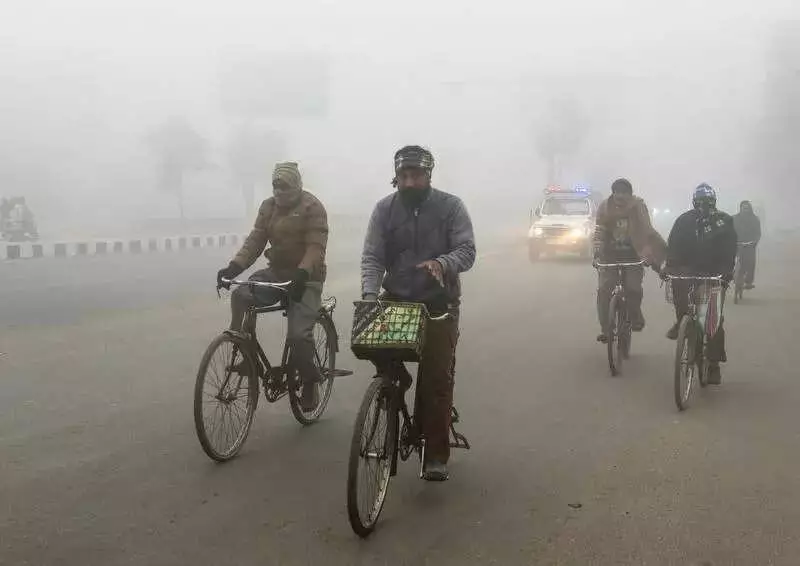
Parts of Punjab and Haryana woke up to a thick blanket of dense to very dense fog on Wednesday, severely disrupting normal life and bringing visibility down to zero in several areas. The intense fog conditions created near-whiteout situations in major cities across both states, coupled with a significant dip in temperatures.
Widespread Disruption and Recorded Temperatures
The fog severely impacted cities including Amritsar, Ludhiana, Patiala, and Halwara in Punjab, and Ambala, Hisar, and Bhiwani in Haryana. In the plains, Gurgaon recorded the lowest minimum temperature at 3.6°C. The India Meteorological Department (IMD) has stated that these challenging conditions are set to persist.
Temperature data revealed a mixed trend. In Punjab, the average minimum temperature saw a slight rise of 0.2°C compared to Tuesday and was above normal by 2.3°C. Gurdaspur recorded the state's lowest minimum at 5.2°C, while Roopnagar saw the highest at 11°C. In contrast, Haryana experienced a fall of 0.9°C in average minimum temperature, which was near normal. After Gurgaon, Rohtak recorded 4.2°C and Narnaul 4.5°C.

IMD Forecast: Fog, Cold Wave, and Rainfall
According to the IMD, dense to very dense fog is very likely to continue during night and morning hours over Punjab, Haryana, and Chandigarh until January 5. Furthermore, cold day conditions are expected in isolated pockets over these regions on January 1.
The forecast also warns of a cold wave in isolated pockets of Himachal Pradesh from January 2–4, and over Punjab, Haryana, and Chandigarh from January 3–5. This period will be preceded by some precipitation due to a western disturbance.
Rainfall and Snowfall Predictions
The western disturbance is likely to cause:
- Scattered to fairly widespread light to moderate rainfall and snowfall over Himachal Pradesh during December 31–January 2.
- Isolated to scattered light rainfall over Punjab, Haryana, and Chandigarh on December 31 and January 1.
Temperature Trends for Northwest India
The IMD has outlined a fluctuating temperature pattern for northwest India. A gradual rise in minimum temperature by 2°C–4°C is very likely over the next two days. However, this will be followed by a fall of 2°C–4°C for the subsequent three days, with no significant change expected after that. Residents are advised to take necessary precautions against the cold and plan travel carefully due to the persistent low visibility.