

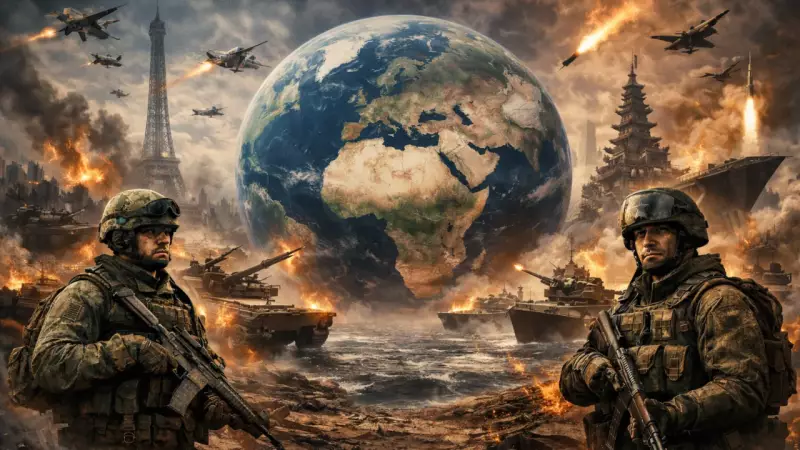
The year 2025 will not be remembered in history for a landmark peace treaty or a decisive end to any major war. Instead, it was a year defined by the grim continuity and normalisation of multiple, simultaneous conflicts across the globe. From Europe's eastern flank to the heart of West Asia, and from the highlands of the Caucasus to the jungles of Southeast Asia, the world grappled with overlapping crises that showed little sign of resolution.
The Normalisation of Persistent Conflict
Rather than a single new war breaking out, 2025 was characterised by the entrenchment of existing hostilities. More than half of the world's population lived in countries affected by or engaged in armed conflict or political violence, according to data from several conflict trackers and international agencies. Ceasefires, where they existed, proved fragile and temporary. Few conflicts moved decisively toward a permanent settlement, even as the humanitarian costs mounted to staggering levels.
The world entered the final months of 2025 with more active flashpoints than it began with. Conflicts overlapped across regions, creating a complex web of instability. The human cost was immense, with tens of millions displaced globally, children disproportionately affected, and strained international aid systems pushed to their limits.

Major Conflict Zones: A Global Overview
Europe's Unresolved Wars
At the heart of Europe's ongoing instability remained the Russia-Ukraine war, now in its fourth year. Despite a high-profile peace summit in Switzerland attended by dozens of nations (but not Russia), no breakthrough was achieved. Fighting continued along shifting frontlines, with neither side securing a decisive military advantage. The conflict's ripple effects kept energy markets volatile and triggered a sustained surge in European defence spending.
In the Balkans, tensions between Kosovo and Serbia flared intermittently, keeping the region on edge and NATO peacekeepers alert. While large-scale violence was avoided, sporadic clashes and political standoffs underscored the persistent fragility.
West Asia: The Gaza War and a Dangerous Escalation
The war in Gaza, launched after the October 7, 2023 attacks, extended through 2025 with only intermittent pauses. Gaza health authorities, cited by the UN, reported over 50,000 Palestinian deaths, while Israel stated over 1,200 of its people were killed, mostly in the initial attacks. Ceasefire proposals, including a 20-point plan, led to temporary halts but collapsed repeatedly.
The shadow war between Israel and Iran entered a perilously open phase. Tensions escalated into direct military strikes, culminating in a major turning point in June. The United States joined Israel in coordinated airstrikes on three major Iranian nuclear facilities – Fordow, Natanz, and Isfahan. US President Donald Trump announced the operation, calling it a "very successful military operation" aimed at crippling Iran's enrichment capacity. Iran condemned the attacks but stopped short of all-out war, responding with rhetoric and indirect retaliation through regional proxies.
Asia: From Myanmar's Civil War to South Asian Tensions
In Myanmar, the civil war sparked by the 2021 military coup deepened further. The junta faced coordinated offensives from ethnic armed groups and pro-democracy militias. UN estimates indicate over 2.5 million people have been displaced since the coup, with thousands killed.
South Asia witnessed a significant escalation between nuclear-armed neighbours. In April, 26 innocent civilians were killed in a terror attack in Pahalgam. In response, India launched Operation Sindoor from May 7 to May 10, targeting terror infrastructure in Pakistan-occupied Kashmir and Pakistan. A larger conflict was averted after a ceasefire request was communicated between the Director Generals of Military Operations of both countries.

Even typically tranquil Southeast Asia saw unexpected friction. Thailand and Cambodia experienced sporadic border violence, a reminder of how long-standing disputes can quickly resurface. The tensions escalated to the point where historical and religious symbols, including an idol of Lord Vishnu in Cambodia, were reportedly attacked.
Other Flashpoints: Caucasus, Africa, and the Caribbean
Post-war tensions between Armenia and Azerbaijan remained high, with border incidents and deep mistrust threatening the fragile peace. Earlier in the year, a US-brokered deal was signed at the White House, but it did not fully quell the underlying strains.
In Africa, the eastern Democratic Republic of Congo remained a hotspot, with fighting drawing in neighbouring Rwanda. The United Nations warned the conflict risked spiralling into a broader regional confrontation. Meanwhile, in the Caribbean, Haiti approached "a point of no return," as a senior UN official warned, with armed gangs tightening their grip and state authority collapsing in parts of the capital.
A World Between Diplomacy and Destruction
The year 2025 demonstrated a stark reality: the international system struggled to keep pace with events on the ground. Diplomatic efforts, including those by major powers, often struggled or failed to yield lasting results. While peace remained a stated goal, the path to achieving it grew increasingly elusive. The world ended the year caught between the imperative for diplomacy and the relentless reality of destruction, with no clear exit from the era of normalised, multi-front conflict.





