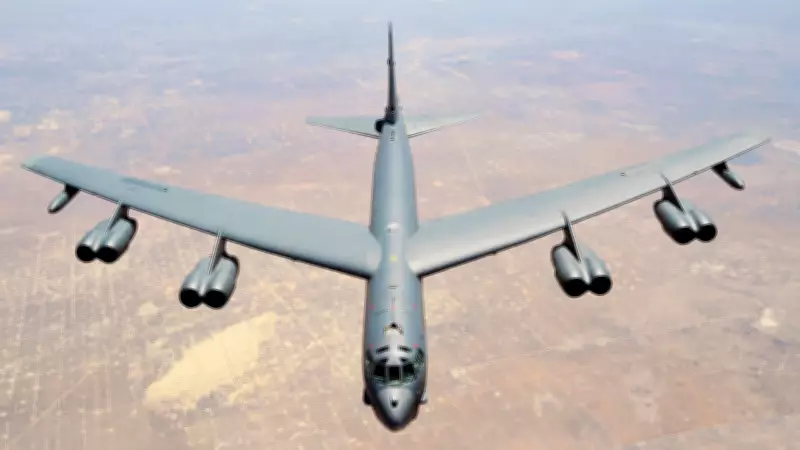
B-52 Stratofortress: Cold War-Era US Bomber's Role in Striking Iran Under Operation Epic Fury
Fresh footage released by the United States military showcases B-52 Stratofortress bombers taking off as Washington escalates strikes against Iranian targets as part of Operation Epic Fury. According to the US Central Command, B-52 bombers were deployed within the first 100 hours of the operation, targeting Iranian ballistic missile infrastructure and command-and-control posts.
American airpower remains unmatched. The B-52 Stratofortress has been utilized in every major conflict since 1965. During the initial phase of Operation Epic Fury, B-52s struck Iranian ballistic missile and command and control posts, as stated by the US Central Command in a social media post.
Despite being designed in the early years of the Cold War, the aircraft continues to be one of the most powerful long-range bombers in the American arsenal, proving its relevance in contemporary warfare.

What is the B-52 Stratofortress?
The B-52 Stratofortress is a long-range heavy bomber operated by the United States Air Force. First conceived in 1946 and entering service in 1955, it was originally designed to deliver nuclear weapons against the Soviet Union. Over the decades, however, the aircraft has evolved into a multi-role bomber capable of carrying both nuclear and conventional weapons.
The latest operational version, the B-52H, remains one of the most versatile aircraft in the US fleet and is expected to remain in service until at least the 2050s, demonstrating its longevity and adaptability.
How the Bomber Works
The B-52 is powered by eight jet engines, providing it with the ability to fly long distances while carrying extremely heavy payloads. Key capabilities include:
- Range: Approximately 8,800 miles (14,000 km) without aerial refueling
- Altitude: Up to 50,000 feet
- Payload capacity: Nearly 70,000 pounds (32,000 kg) of weapons
- Speed: High subsonic cruise speeds suitable for long-range strike missions
The bomber can carry a wide range of munitions, such as precision-guided bombs, air-launched cruise missiles, naval strike weapons, and conventional and nuclear payloads. Because it can launch long-range stand-off missiles, the aircraft does not always need to enter heavily defended airspace to hit targets, enhancing its operational safety.
Why the B-52 is Still Used Today
While stealth aircraft like the B-2 Spirit often draw attention, the B-52 remains crucial due to its payload capacity, endurance, and cost efficiency. Unlike stealth bombers that rely on invisibility, the B-52 functions as a high-capacity flying weapons platform capable of striking multiple targets in a single mission.
Its ability to stay airborne for long durations and fire stand-off weapons from safe distances makes it particularly useful in sustained military campaigns, such as Operation Epic Fury.
Role in the Iran Strikes
US officials state that the objective of the current strikes is to cripple Iran's missile infrastructure and military command networks. During Operation Epic Fury, B-52 bombers were used to target ballistic missile facilities and command posts across Iran.
A statement from the White House indicated that the operation had destroyed thousands of high-value targets, including missile sites, air defence systems, production facilities, and launch platforms. It also claimed significant damage to Iran's naval assets and missile production capabilities.
Nicknamed BUFF
Called BUFF — Big Ugly Fat Fellow — the B-52 has served in nearly every major US conflict since the 1960s, including the Vietnam War, the Gulf War, and the War in Afghanistan. Today, the US Air Force operates 76 B-52 aircraft, many of which have undergone extensive avionics and weapons upgrades.
More than seventy years after its first flight, the aircraft remains a central pillar of American long-range strike capability, proving that even a bomber designed in the 1950s can still shape modern warfare.