In a landmark ruling with significant implications for farmers, the Nagpur bench of the Bombay High Court on Friday held that compensation cannot be denied for crop damage caused by wild birds, even if such species are not explicitly mentioned in government resolutions (GRs).
Case Background
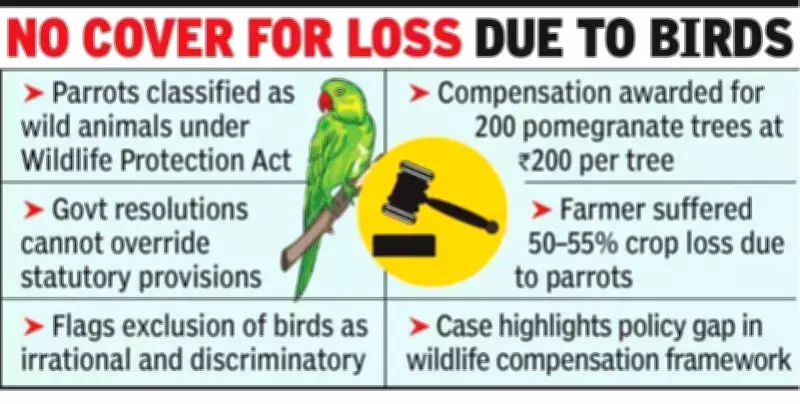
The case stemmed from a petition filed by Wardha farmer Mahadeo Dekate, who sought compensation after parrots destroyed a substantial portion of his pomegranate crop in 2016. Dekate cultivated nearly 800 pomegranate trees over 1.5 acres near Bor Wildlife Sanctuary. A field inspection confirmed that 50-55% of the fruit was damaged by parrots, leading to losses of Rs 25 lakh.
Court's Observation
Despite the assessment, authorities declined compensation, citing absence of provisions covering birds like parrots in GRs issued in 2010 and 2013. These policies provide compensation only for damage caused by specified wild animals such as wild boar, deer, monkeys, and elephants.

"Just because the GR does not include birds like parrots, it would not be sufficient to deprive the petitioner from getting compensation," a division bench comprising Justices Urmila Joshi-Phalke and Nivedita Mehta held.
The bench rejected the state's position, observing that parrots are classified as "wild animals" under Schedule II of the Wildlife Protection Act, 1972. Allowing the petition, the court directed the state to compensate Dekate for 200 pomegranate trees at the rate of Rs 200 per tree.
Legal Reasoning
"The law expects every citizen to be a protector of wild animals. It cannot be expected to suffer losses because of these animals. Or the very purpose of giving protection to animals would be frustrated. The affected persons may resort to their own defences for protecting crops and fruit-bearing trees, which may entail harm to wild animals," the bench said.
The judges noted that the objective of compensation schemes is to offset losses suffered by farmers due to wildlife. Limiting compensation to select species, while ignoring damage caused by other protected animals, would violate principles of equality under Article 14 of the Constitution.
Implications
This ruling sets a precedent for farmers across Maharashtra and potentially the country, ensuring that compensation claims for crop damage by wild birds and animals not explicitly listed in GRs are not automatically rejected. The decision reinforces the duty of the state to protect both wildlife and the livelihoods of farmers.