

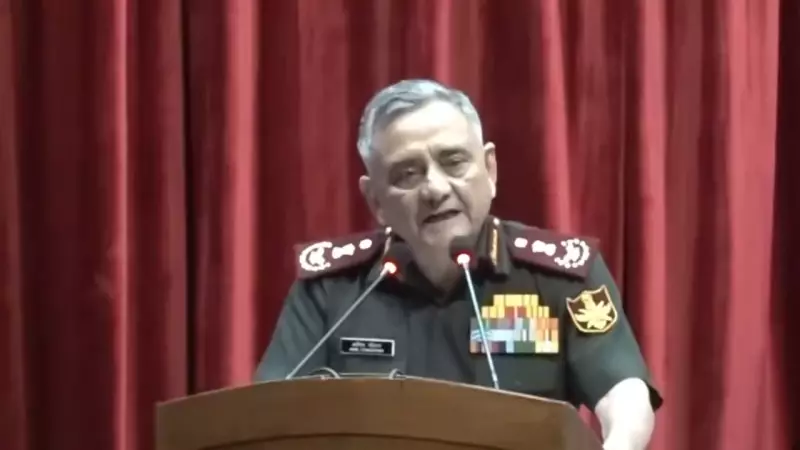
India's top military commander, Chief of Defence Staff (CDS) General Anil Chauhan, has laid out a crucial three-fold strategic approach for the nation to effectively deter terrorism and handle security challenges from its nuclear-armed neighbours. He presented this vision during an address at IIT Bombay on Tuesday.
A Strategic Framework for a Nuclear Neighbourhood
General Chauhan stated that India's defence planning must be grounded in the stark reality of facing two nuclear-capable adversaries. He identified China as a "nuclear weapon state" and Pakistan as a "nuclear-armed state." This fundamental fact, he argued, means India must ensure it never breaches the threshold of nuclear deterrence while remaining prepared for varied conflict scenarios.
"The question is what kind of threats and challenges India should be prepared for. I think this should be based on two major facts. One, both our adversaries—one is a nuclear weapon state and the other is a nuclear-armed state. Hence, we should not allow that level of deterrence to be breached," the CDS explained.

The Three Pillars of India's Defence Posture
Elaborating on the required approach, General Chauhan detailed the three key pillars. First, the armed forces must be ready for short-duration, high-intensity conflicts designed specifically to deter terrorism. He cited the successful Operation Sindoor as a prime example of this model.
"We should be prepared to fight short-duration, high-intensity conflicts to deter terrorism—something like Operation Sindoor," he said.
The second pillar involves preparation for a land-centric, long-duration conflict, acknowledging unresolved territorial disputes. However, the General emphasized that such a scenario should be avoided through diplomacy and deterrence.
Creating Asymmetry and Mastering New Domains
The third and final strategic pillar focuses on innovation and asymmetry. General Chauhan stressed the need to exploit new domains of warfare and create decisive asymmetries against a conventionally weaker adversary, a clear reference to Pakistan.
"We must exploit new domains and create asymmetry with our weaker adversary, while ensuring these asymmetries are not exploited by other nations," he remarked. He added that terrorism will remain a persistent threat, necessitating both defensive and offensive responses.
The Changing Face of Modern Warfare
The CDS provided insights into the evolving nature of combat, noting that modern warfare is becoming shorter, faster, and smarter. He again pointed to Operation Sindoor to illustrate this shift, where decisions and effects are compressed into a very short, high-tempo timeframe.
"Warfare in the new domains is faster and smarter. It is also shorter in duration, and the tempo of such warfare is very, very high. Decisions are compressed in time, and the effects of war are felt almost instantly. This was clearly visible in Operation Sindoor, a conflict that lasted only about four days and gave India a decisive victory," General Chauhan noted.
Operation Sindoor was a brief military engagement between India and Pakistan from May 7 to May 10. The Indian armed forces targeted terrorist camps in Pakistan and Pakistan-occupied Kashmir. This operation was a direct retaliation for the April 22 Pahalgam terror attack, which claimed the lives of 26 civilians and was carried out by terrorists backed by Islamabad. The hostilities concluded with a ceasefire on May 10 following a request from Pakistan.






