

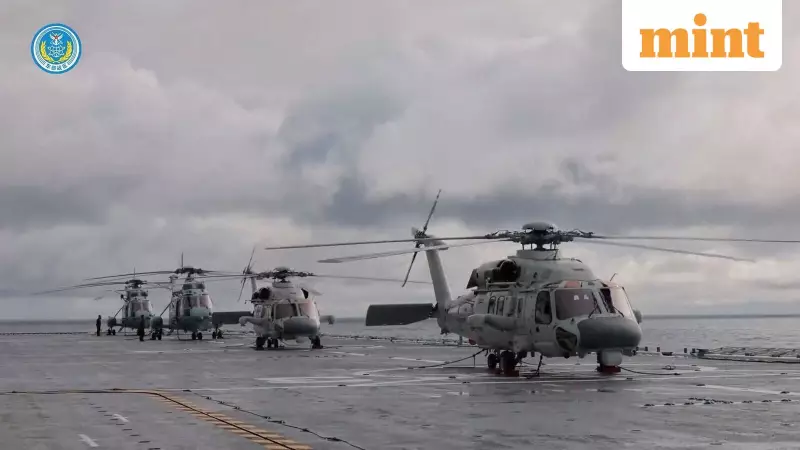
China launched major military exercises around Taiwan on Monday, a move set to disrupt the travel plans of more than 100,000 international passengers. Beijing described the drills as a "stern warning" against what it calls separatist forces on the island and against foreign interference, a clear reference to the United States and Japan.
Scale and Scope of the Military Drills
The People's Liberation Army's Eastern Theater Command is conducting the large-scale exercises in the Taiwan Strait and in areas to the north, southeast, and southwest of Taiwan. Senior Colonel Shi Yi, a spokesperson for the command, stated the activities include combat readiness patrols in sea and air, "joint seizure of comprehensive superiority," and blockades on key ports.
This marks the first time the command has explicitly stated its goal is "all-dimensional deterrence outside the island chain." Chinese propaganda posters highlighted targets around the island, with a specific focus on sealing off the crucial deep-water ports of Keelung in the north and Kaohsiung, Taiwan's largest port, in the south.

Notably, the visuals showed an armada of civilian vessels with ramps and open decks, suggesting the potential for amphibious assault operations. China is mobilising these ships as part of the drills.
Taiwan's Response and Accusations
Taiwan swiftly condemned the actions. Its Defense Ministry stated that appropriate forces were deployed and rapid response exercises were underway to maintain combat readiness. In a strong rebuke, the ministry labeled the Chinese Communist Party as "an aggressor and the biggest destroyer of peace."
Deputy Chief of the General Staff for Intelligence, Hsieh Jih-sheng, warned that the live-fire exercises not only put military pressure on Taiwan but could also create "more complex challenges and impacts for the international community and neighbouring countries."
In a show of resilience, Taiwan's Defense Ministry released a video showcasing its military assets, including multiple French-made Mirage-2000 aircraft conducting landings at an air force base.
The External Factors: US and Japan
While China's official statement did not name specific countries, the reference to "external interference" is widely understood to target the United States and Japan. Beijing is particularly angered by recent US arms sales to Taiwan. Last week, it sanctioned 20 US companies and 10 executives after Washington announced a potential $10-billion weapons package for Taipei.
If approved by the US Congress, this would be the largest-ever US weapons sale to the self-ruled island. On the other side, Japan's political leadership, including Prime Minister Sanae Takaichi, has indicated that its military could get involved if China takes action against Taiwan, further raising tensions in the region.
The immediate and most tangible impact of the drills is on global travel and commerce. Taipei has confirmed that over 100,000 international travelers are affected by the large-scale military activities, facing delays and rerouted flights due to the closure of air and sea space around the island.






