El Mencho Killed: Mexico's Most Wanted Drug Lord's Reign Ends in Military Raid
Nemesio Oseguera Cervantes, infamously known as El Mencho, the most wanted drug lord in Mexico, has met a violent end. As the leader of the Jalisco Cartel New Generation (CJNG), he built one of the country's most militarized criminal organizations, transforming it into a formidable force with specialized armed units, advanced weaponry, and even drone capabilities. His reign came to a dramatic conclusion during a high-stakes military operation in the mountain town of Tapalpa.
Fatal Raid in Tapalpa
The 59-year-old leader was fatally wounded during the raid and died while being flown to Mexico City for emergency treatment, according to the defense ministry. The operation was carried out by Mexican special forces with support from the Mexican Air Force and the National Guard. Authorities stated that the mission was planned and executed domestically, though it relied on complementary information provided by the United States, highlighting international cooperation in combating organized crime.
Drone Operators: CJNG's Specialized Unit
A newly identified patch underscores the CJNG's growing military sophistication. In April 2023, authorities documented a patch belonging to a specialized drone unit called Drone Operators (Operadores Droneros). This group, active in the western states of Michoacán and Guerrero, first began using drones to drop explosives in 2020. Recent reports suggest the CJNG has provided training to temporary allies, including La Familia Michoacana, to carry out similar attacks, spreading its tactics across regions.

Symbols of Loyalty and Militarization
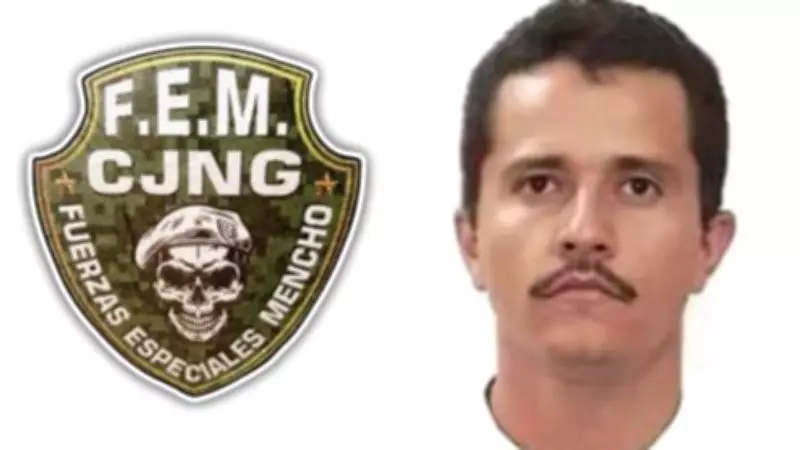
Cartel patches and emblems have become key tools for promoting loyalty to El Mencho and reinforcing the CJNG's internal structure. One emblem, associated with the Fuerzas Especiales Mencho (Mencho Special Forces), is allegedly worn by gunmen responsible for El Mencho's personal protection. Based in rural Jalisco, this unit has been linked to some of the cartel's most infamous attacks, including the 2015 downing of a military helicopter. Despite years out of public view and persistent rumors of his death, El Mencho's name and image remain central in CJNG propaganda.
Several patches feature a rooster, referencing one of El Mencho's nicknames, the Lord of the Roosters (El señor de los gallos). This reflects his reported affinity for cockfighting, a pastime popular in rural regions such as Michoacán and Jalisco. Another emblem, resembling that of the Mencho Special Forces, belongs to Grupo X, a powerful armed wing operating in Michoacán to confront rivals such as Cárteles Unidos and Correa. Authorities first became aware of Grupo X in May 2021 after discovering an abandoned vehicle displaying the emblem.
CJNG's Arsenal and Broader Trends
The cartel's arsenal includes military-grade US weapons, homemade armored vehicles, and bomb-dropping drones, which pose a major challenge for Mexico's army, police, and National Guard. Authorities say such weapons may enter Mexico through multiple routes: Central American stockpiles from the 1980s, losses from U.S. military inventories, or sales abroad and on the black market.
The CJNG's militarization reflects a broader trend among Mexican criminal groups. Patches and military-style insignia, which have become a hallmark of cartel organization and loyalty, were first popularized by groups such as Los Zetas, whose founders were deserters from an elite Mexican army unit. Initially enforcers for the Gulf Cartel, the Zetas soon broke away in the early 2000s and expanded nationwide. Their iconography, including a Z alongside maps of Mexico and their home state of Tamaulipas, reflected their military roots.
After 2012, when then-president Felipe Calderón deployed the army directly against cartels, militarized imagery and structure became even more widespread. Insignias helped criminal groups build internal identity, promote cohesion, or reinforce loyalty to specific leaders like El Mencho, showcasing how cartels have evolved into quasi-military entities in Mexico's ongoing drug war.