

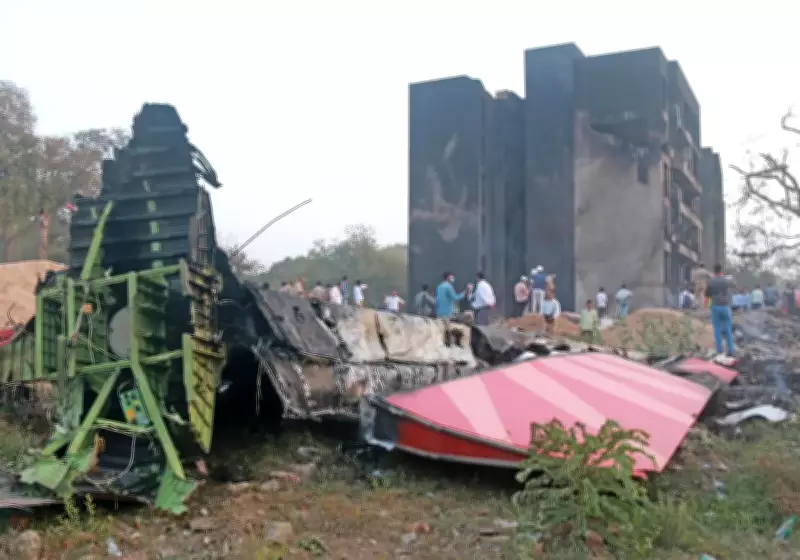
The Federation of Indian Pilots (FIP) on Thursday alleged serious shortcomings in the investigation into the Air India AI171 crash, questioning both the technical direction of the probe and the lack of transparency of the Aircraft Accident Investigation Bureau (AAIB).
Allegations of Ignored Health Monitoring Codes
FIP president Captain C S Randhawa said the Boeing 787 transmitted at least 10 encrypted “health monitoring” codes before the crash and claimed the messages were ignored. “The investigation had prematurely focused on pilots while failing to adequately examine possible electrical failures in the Boeing 787 aircraft,” Randhawa said.
On June 12, 2025, the London-bound AI171 flight crashed into the BJ Medical College hostel in Ahmedabad’s Meghaninagar area, killing 260 persons, including 241 on board and 19 on the ground. Only one passenger survived.

ACARS Messages Omitted from Preliminary Report
Addressing mediapersons in Ahmedabad on the eve of one year of tragedy on June 12, Randhawa alleged that Aircraft Communications Addressing and Reporting System (ACARS) messages were omitted from the preliminary report.
“There are at least 10 specific codes that were transmitted 15 minutes before departure and during the flight. These codes can be decoded only by Boeing—not even Air India can read them,” Randhawa said. “The system transmits hundreds of parameters, including N1 and N2 engine speeds, oil pressure, and hydraulic pressure. Why has this data not been shared with the AAIB? We have written to the Ministry to demand these transcripts be decoded immediately.”
Concerns Over Investigation Team Composition
The federation also raised concerns about the investigation team’s composition and capacity, alleging conflict of interest as two members were deputed from the Directorate General of Civil Aviation (DGCA). It was also alleged that the five-member board lacked specialist avionics expertise. “There are only five people on the investigation board for this entire country. They are handling AI 171 crash, the Ajit Pawar helicopter crash, and multiple other accidents simultaneously.” Randhawa questioned. “One AAIB investigator has only flown small aircraft. They do not have the expertise for a machine as complex as the 787. This is why they had to send the black boxes to the US twice, despite the Ministry claiming we have the facilities in Delhi to decode them.” He added, “When you constitute an independent investigation board, it should remain independent,” he said.
Supreme Court Appeal for Judicial Probe
The federation has approached the Supreme Court seeking a judicial probe under Rule 12 of the AAIB Rules, alleging lack of transparency in the investigation. Randhawa said the apex court, during initial hearings, observed that it was premature to blame pilots and restrained people from making such statements.
ICAO Annex 13 Norms and Expert Induction
Randhawa cited ICAO Annex 13 norms and said, “Accident investigation boards should include highly qualified subject matter experts and alleged that this requirement had not been adequately fulfilled in the present case. Retired Boeing 787 operations examiner Captain RS Sandhu was inducted as a subject matter expert after repeated requests from the federation.”
Delay in Interviewing Sole Survivor
Randhawa also criticized the AAIB for its failure to interview the sole survivor of the 260-person tragedy until 10 months after the crash. He contrasted this delay with the “harassment” of the pilot’s 91-year-old father by investigators seeking to prove a suicide motive.
“The survivor saw flickering lights in the cabin during take-off and landing. Flickering lights are a clear symptom of an electrical problem,” Randhawa said. “He also heard a ‘bang’—an explosion—which we believe occurred in the tail, which was found in a very poor condition. Why was this testimony delayed while investigators were busy questioning a pilot’s father about the dead pilot’s mental state?”

Aircraft Technical Issues Prior to Crash
On aircraft condition, Randhawa alleged the aircraft had reported technical issues before operating AI171, saying it arrived from Delhi as Air India Flight 423 and developed a stabiliser-related defect, after which certain motors were replaced before it was declared serviceable at 0640 GMT.
He also referred to an alleged electrical short-circuit incident involving another Air India Boeing 787 operating the Vienna-Delhi route on the same day, claiming water flooding in the electronic bay forced passengers to deplane.
History of Electrical Problems on Boeing 787
Randhawa said Boeing 787 aircraft have a history of electrical and technical problems globally. “Boeing 787 aircraft have historically faced multiple electrical issues globally, including lithium battery failures, electrical fires, RAT deployment problems and water seepage into electronic bays,” Randhawa said. “There is no pneumatic system in this aircraft. Even the brakes rely heavily on electrical systems,” he said, citing the aircraft’s reliance on generators, batteries and backup electrical redundancies.





