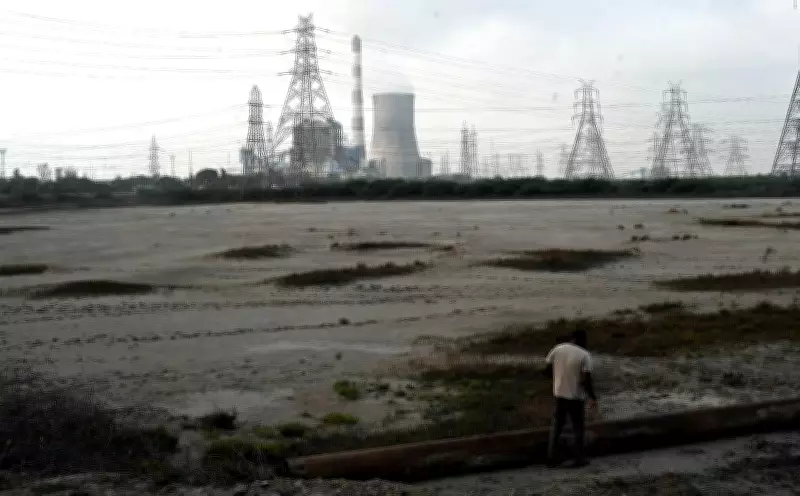
In the fishing hamlet of Nettukuppam at Ennore, approximately 150 homes have been enduring a severe health crisis for several years. Residents suffer from dust, wheezing, and year-round damp terraces covered with blackish-grey deposits. The cause lies less than a kilometer away: vast quantities of fly ash mixed with river sand remain uncleared along the floodplains of the Kosasthalaiyar River, near the North Chennai Thermal Power Station. This persists despite a National Green Tribunal (NGT) order issued four years ago mandating its removal.
Health Impact on Locals
These fly ash particles, a powdery residue from burning coal in thermal power plants, are remnants of a 2017 leak in Tangedco's fly ash slurry pipelines. Thousands of tonnes of toxic ash flowed into Ennore Creek and the Kosasthalaiyar River at that time. According to Aravindan, a resident of Nettukuppam, problems arising from proximity to fly ash have become a part of daily life for villagers living within a 4-5 kilometer radius. Children, in particular, exhibit symptoms of wheezing at night.
NGT Order and Ground Reality
The NGT had ordered the removal of fly ash deposited along the creek, river bed, and flood plains, as well as the fixing of leaks in pipelines carrying ash slurry. However, a visit by Times of India to Ennore and nearby hamlets revealed that Tangedco is lagging behind. Along a 1.5-kilometer stretch of flood plains beside the Ennore Pipeline Road, which houses Tangedco pipelines, ash-mixed river sand remains spread over acres. Hot water leaks from at least two holes along the pipeline, and several sections are rusty. Residents reported that desilting of the Kosasthalaiyar River is incomplete in several sections, particularly near Athipattu Panchayat. Srinivasan, a resident-activist, noted that fly ash along the Buckingham Canal side also needs clearance; during low tide, fishermen can see ash at the bottom of the river bed.

Government Response and Progress
Tiruvallur Collector M. Prathap, who launched projects worth ₹28 crore to desilt the river last year, stated that about 80% of the first phase is complete. However, as it is a continuous project, approval is required to begin the second phase. The thermal plant generates 2,000 tonnes of fly ash every day. Dry ash is stored in silos within the plant premises, while wet ash mixed with water is dumped into an ash dyke at Seppakkam through four pipelines. From there, cement and construction industries collect the ash, and the water is filtered and sent back to the plant through two recovery pipelines.
Tangedco officials claimed that since the court order, 12.39 lakh tonnes of ash have been removed in a phased manner by floating tenders and coordinating with the water resources department. They stated that all ash pipelines have been replaced, despite missed deadlines, and only the recovery pipelines carrying water remain old, but their leaks have been plugged. Regarding fly ash removal, only select portions remain, and tenders will be floated soon. Some tenders are on hold due to the recent elections.
Regulatory Oversight
Tamil Nadu Pollution Control Board (TNPCB) member-secretary E. Saravanakumar said the Manali-Ennore Restoration and Rejuvenation Council, formed in 2024, keeps pollution levels in check. The joint chief engineer conducts regular inspections, and no fly ash leak has occurred after the 2017 incident. However, a TNPCB engineer acknowledged that water pipelines have occasional leaks, but all fly ash pipelines have been replaced and strengthened with cement holdings.
Environmental Concerns and Livelihood Issues
Environmentalists argue that the area needs a complete revamp. According to Save Ennore Creek Campaign volunteer Durga Moorthy, at the ash dyke, ash seeps into the ground due to lack of proper lining and then into canals. The state government conducted a study with the Indian Institute of Technology Madras to strengthen the ash pond and reduce pollution, but progress has been minimal. Govinda Rao, managing director of Tamil Nadu Power Generation Corporation Limited, said the study is complete, and efforts to strengthen it will begin soon.
For local fishermen, the pollution has become a livelihood issue. Devan, a fisher-resident, lamented that crabs and prawns used to be abundant, but now even the fish have been poisoned.