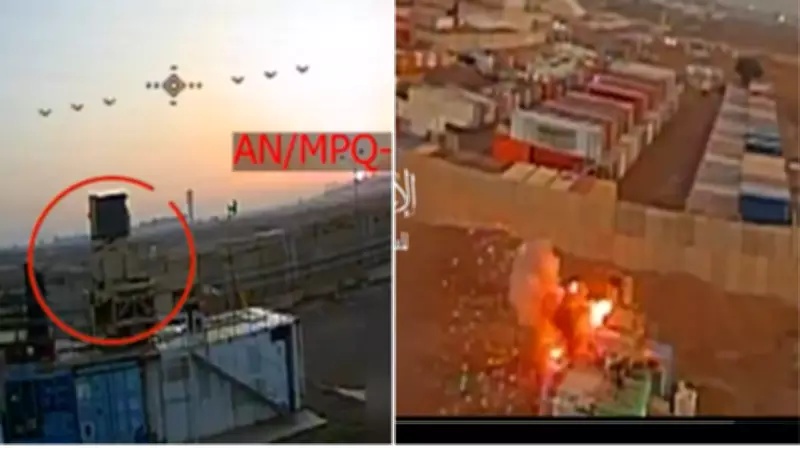
Video Shows FPV Drone Breaching US Base in Baghdad, Highlighting New Warfare Threat
A grainy, fast-moving video circulating online has sent shockwaves through military circles, depicting a small First-Person View (FPV) drone gliding unchallenged over the US Victory Airbase outside Baghdad before crashing into a building. This incident, captured in the footage, is less about the immediate damage inflicted and more about the profound implications it carries for global security and defense strategies.
What Are FPV Drones and Why Are They So Disruptive?
FPV drones are small, remotely piloted quadcopters that transmit live video back to an operator, enabling real-time visual guidance. Originally developed as hobbyist racing devices, they have evolved into low-cost, high-precision guided weapons. According to Forbes, unlike traditional unguided rockets or mortars, FPV drones can search, identify, and strike targets with surgical precision. They boast capabilities such as flying for several kilometers, maneuvering through tight spaces, and hitting specific weak points like fuel tanks, aircraft fuselages, or ammunition dumps.
In the Baghdad attack, the drone appears to conduct a reconnaissance sweep before striking—a tactical advantage conventional weapons lack. This precision transforms them into one of the most disruptive tools on the modern battlefield, offering asymmetric advantages to non-state actors and smaller militaries.

Why Airbases Are Especially Vulnerable to FPV Drone Attacks
Airbases are densely packed with high-value targets, including parked aircraft, fuel depots, munitions stockpiles, and maintenance hangars. Historically, attacks on such facilities relied on indirect fire like rockets, which are cheap but largely ineffective due to their inaccuracy. FPV drones change this equation entirely. Their ability to loiter, scout, and then strike makes them uniquely suited to exploiting the inherent vulnerabilities of airbases.
The Baghdad footage shows a drone flying unopposed for nearly two minutes, highlighting a glaring gap in low-altitude defenses. Even a small warhead can have an outsized impact if precisely placed; for instance, a hit on a fuel truck or an armed aircraft could trigger catastrophic secondary explosions, amplifying the damage far beyond the initial strike.
Lessons from Ukraine’s Drone War and the Fiber-Optic Evolution
The growing threat of FPV drones is not merely theoretical. During Operation Spiderweb, Ukrainian forces demonstrated their devastating potential by covertly transporting drones near Russian airbases and launching them in swarms. Operators, some connected via cellular networks and others assisted by AI, guided these drones onto parked aircraft, reportedly damaging or destroying dozens of planes by targeting fuel tanks and munitions for maximum effect. Crucially, each drone carried only a small payload, with precision—not explosive power—doing the damage.
What makes the Baghdad strike particularly concerning is the apparent use of fiber-optic guidance. Unlike radio-controlled drones, fiber-linked FPVs are physically tethered to the operator through a thin cable. This makes them immune to electronic jamming—a primary defense against drones—and allows them to fly extremely low without losing signal. Such drones can hug the ground, evade radar, and remain virtually invisible to traditional detection systems. Their range has expanded rapidly to tens of kilometers, and their appearance in Iraq suggests a troubling diffusion of advanced battlefield technology, potentially with external backing.
Why FPV Drones Are So Hard to Stop and the Emerging Countermeasures
Defending against FPV drones is proving far more challenging than countering larger drones. Conventional air defense systems are designed for bigger, faster threats, often missing small quadcopters that fly low and slow, evading radar or being mistaken for birds or background noise. Acoustic detection is unreliable in noisy environments like airbases, and fiber-optic drones emit no radio signals to intercept. Even when detected, the response window is extremely short.

Emerging countermeasures include AI-enabled tracking systems, interceptor drones, and directed-energy weapons, but these are still evolving and offer no foolproof shield, especially against coordinated swarm attacks. This vulnerability underscores the urgent need for innovative defense strategies in an era where cheap, precise drones can penetrate high-security installations with ease.
A Warning Shot for Global Security
The Baghdad strike caused limited visible damage, but that may be beside the point. The real message lies in the ease with which the drone penetrated a high-security military installation, serving as a stark warning. With tensions rising across the region and critical sites like Iran’s Kharg Island well within FPV range, the proliferation of these low-cost precision weapons is rapidly reshaping the threat landscape. The next attack may not be so restrained—or so lucky—highlighting the imperative for nations to adapt to this new reality in warfare.