

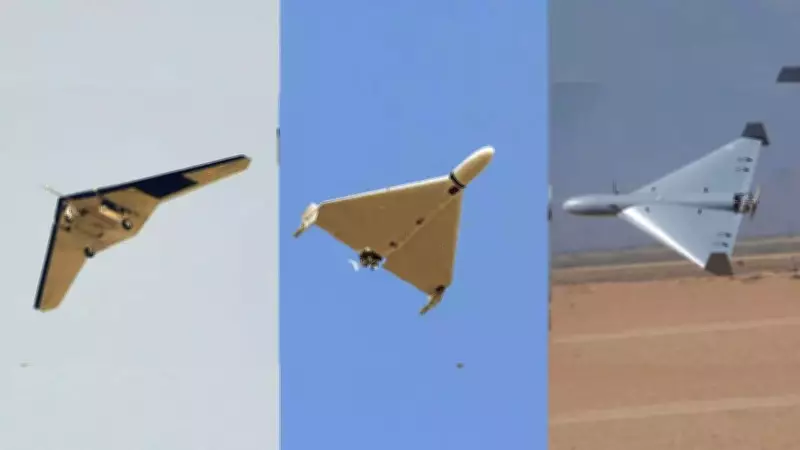
From RQ-170 Sentinel to Shahed to LUCAS: The War for Cheap Drones Comes Full Circle
On a quiet December day in 2011, a secret American surveillance mission ended in an unexpected twist. Instead of returning to its base in Afghanistan, a highly classified drone landed deep inside Iranian territory, marking the start of a transformative era in global military technology.
The Stealth Drone Behind America's Secret Missions
The aircraft was widely identified as the RQ-170 Sentinel, one of the United States' most advanced stealth surveillance drones. Developed by Lockheed Martin's Skunk Works, the same division behind the U-2 spy plane and F-117 stealth fighter, the Sentinel was introduced around 2007. It featured a flying-wing design similar to the B-2 stealth bomber, reducing radar reflections for covert operations in hostile airspace.
Key capabilities of the RQ-170 included:

- High-resolution optical and infrared surveillance sensors
- Signals intelligence equipment for intercepting communications
- Satellite-based command and control links
- Radar-evading coatings and stealth shaping
Operated by the US Air Force for the CIA, the drone played a crucial role in sensitive missions, including surveillance for the 2011 raid on Osama bin Laden in Abbottabad, Pakistan.
The 2011 Incident: A Stealth Drone Lands in Iran
On December 4, 2011, Iran announced it had captured an American stealth drone near Kashmar, about 225 kilometres from the Afghan border. Iranian officials claimed their electronic warfare units took control of the drone's navigation systems, forcing a safe landing by manipulating GPS signals. The US confirmed the loss but attributed it to a technical malfunction, denying hostile interference.
Regardless of the cause, the result was significant: a top-secret American drone fell largely intact into the hands of a geopolitical rival, offering immense intelligence value.
Why the Captured Drone Mattered
The potential insights from the RQ-170 were enormous. Iranian engineers could analyze stealth design principles, radar-absorbing materials, surveillance sensors, satellite communication architecture, and flight control software. This information could help adversaries detect or counter stealth aircraft, including advanced fighters like the F-35.
Washington, concerned enough that President Barack Obama publicly requested the drone's return, was refused. Iran instead displayed the aircraft and vowed to study and reproduce its technology domestically.
Iran's Reverse-Engineering Effort
In the following years, Iran announced drones closely resembling the RQ-170, such as the Shahed-171 Simorgh, a large flying-wing drone for reconnaissance and strike missions, and the Saegheh UAV, a smaller version capable of carrying precision-guided bombs. While analysts debate the extent of replication, the incident undoubtedly accelerated Tehran's drone programme, building on its development since the Iran-Iraq War of the 1980s.
The Expansion of Iran's Drone Arsenal
By the 2010s, Iran had developed a diverse drone fleet, including:
- Shahed-129: A medium-altitude long-endurance drone similar to the MQ-1 Predator
- Mohajer series: Used for reconnaissance and tactical strikes
- Shahed-136: A low-cost loitering munition designed for explosive attacks
The Shahed-136, in particular, gained notoriety in conflicts across the Middle East and the Russia-Ukraine war. Costing tens of thousands of dollars per unit, it epitomized a shift toward cheap, expendable drones that can overwhelm air defences, reshaping modern warfare.
The Unexpected Twist: The US Copies the Concept
In a striking reversal, the United States began adopting low-cost drone concepts inspired by Iranian systems. One example is the Low-cost Uncrewed Combat Attack System (LUCAS) by SpektreWorks, featuring a triangular flying-wing design, small size, low radar signature, and one-way attack capability, with an estimated cost of around $35,000 per unit.
US Central Command officials have deemed such systems indispensable in modern conflicts dominated by low-cost drones, highlighting the irony of the technological cycle.
How One Drone Reshaped the Drone Arms Race
The 2011 RQ-170 incident triggered a chain reaction:

- The US developed advanced stealth drones for high-risk missions
- Iran captured and reverse-engineered the technology
- Iran strengthened its drone programme and created low-cost models
- These drones spread across regional conflicts
- The US adopted similar low-cost concepts for modern warfare
This episode illustrates how military innovation rarely follows a linear path. Technology spreads, evolves, and often returns in unexpected forms. Today, drones are a defining weapon in modern conflict, used by major powers, smaller states, and non-state groups alike, with roots tracing back to a single stealth aircraft lost over Afghanistan.





