

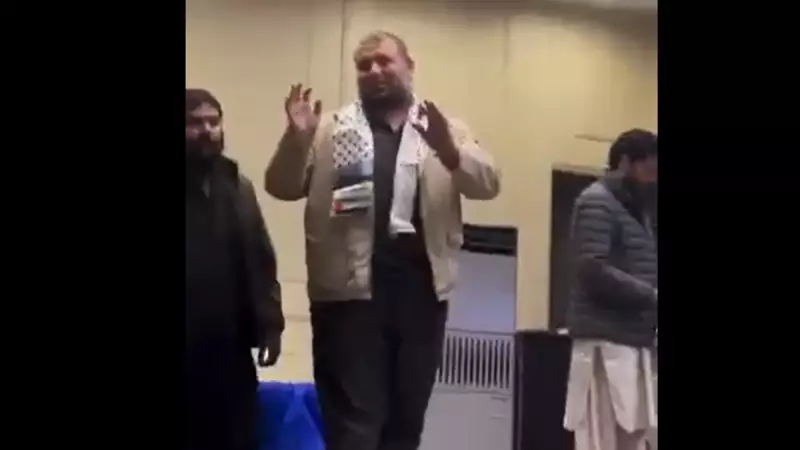
In a development that underscores the deep and dangerous nexus between international terrorist groups, a senior commander of the Palestinian militant organization Hamas was recently seen attending a training camp of the Pakistan-based Lashkar-e-Taiba (LeT) as the chief guest. The presence of Hamas terrorist Naji Zaheer at the camp in Pakistan's Punjab province has raised serious alarms about the collaboration between groups targeting different regions but united by a common extremist ideology.
Video Evidence Reveals Terrorist Gathering
Exclusive video footage, which has now surfaced, provides visual confirmation of the event. The video shows Naji Zaheer, a known figure within Hamas's military wing, the Izz ad-Din al-Qassam Brigades, being honored at a gathering organized by Lashkar-e-Taiba. The location has been identified as Gujranwala, a city in Pakistan's Punjab province. In the video, Zaheer is seen delivering a speech to a crowd of trainees and militants, effectively endorsing the activities of the LeT, which is responsible for numerous attacks in India, including the horrific 2008 Mumbai terror attacks.
The event appears to be a coordinated show of strength and solidarity. The attendance of a Hamas leader at a LeT camp is not a casual meeting but a significant symbolic gesture, indicating shared resources, training methodologies, and possibly strategic planning between the two proscribed organizations. This collaboration poses a direct threat not only to regional stability in South Asia but also to international security.

Who is Hamas Terrorist Naji Zaheer?
Naji Zaheer is not a low-level operative. He is a prominent commander within Hamas's military infrastructure. His participation as the chief guest at the Lashkar camp elevates the importance of the meeting and signals high-level approval for such cross-group interactions. His expertise in guerrilla warfare and urban combat, honed in the Gaza Strip, could be of significant value to LeT operatives, who often employ similar tactics in Jammu and Kashmir and other parts of India.
This incident blatantly exposes Pakistan's continuing role as a safe haven for internationally banned terrorist organizations. Despite repeated claims of cracking down on terror groups, the ability of LeT to openly organize a training camp and host a foreign terrorist leader highlights the impunity with which these entities operate on Pakistani soil. The Gujranwala camp event is a stark reminder of the persistent infrastructure that supports cross-border terrorism.
Implications for Regional and Global Security
The convergence of Hamas and Lashkar-e-Taiba interests has profound implications. Firstly, it represents the globalization of jihadist networks, where groups with geographically distinct primary theaters (Middle East and South Asia) are pooling ideological and operational resources. This fusion can lead to more sophisticated and deadly attacks.
Secondly, for India, this is a grave concern. Lashkar-e-Taiba, with its long history of targeting India, gaining insights or support from a group like Hamas, which has experience in tunnel warfare, rocket attacks, and sustained conflict with a modern military, could enhance its capabilities. It underscores the multi-front challenge India faces from state-sponsored terrorism.
The international community, particularly countries advocating for counter-terrorism cooperation, must take serious note of this development. The video evidence from Gujranwala is irrefutable proof of active collusion. It demands a concerted global response to pressure Pakistan to dismantle the terror sanctuaries that exist within its borders and to hold accountable those who facilitate such meetings.
In conclusion, the appearance of Hamas terrorist Naji Zaheer at the Lashkar-e-Taiba terror camp is more than a news headline; it is a flashing red signal. It reveals the evolving, interconnected nature of terrorist threats and the urgent need for vigilant, uncompromising international action to sever these deadly links before they yield even more catastrophic results.






